

Ski boot fitting for wide and high-volume feet: complete 2026 guide

Wide-foot ski boot fitting is the process of matching shell width, instep space, and heel retention to your feet so you can steer accurately without excessive pressure. A wide forefoot does not automatically mean you need a larger boot or more room everywhere.
TL;DR
- Ski boot fitting for wide feet starts with shell shape, not extra length.
- Skiboulder suits Boulder skiers seeking boot fitting alongside rentals, tuning, and retail gear.
- High-volume ski boots need enough instep space without sacrificing heel hold.
- Persistent numbness, sharp pain, or discoloration means stop and reassess the fit.
Why ski boot fitting matters for wide-footed skiers
A ski boot connects your lower leg to the ski. If your forefoot is compressed, loosening every closure can relieve pressure while also letting your heel move. If you choose a longer shell instead, you change more than width: you also change where your ankle and lower leg sit inside the boot.
For your 2026 boot search, separate forefoot width, instep height, and heel volume before comparing models. Those dimensions do not increase together in every foot or every shell. The outline in what happens during a professional ski boot fitting helps you understand the assessment before discussing individual boots.
The right wide-foot fit creates room where your foot needs it and retention where the ski needs it. General roominess is not the goal. Controlled movement is.
How to fit ski boots for wide and high-volume feet
1. Map your pressure before changing equipment
Start with a simple record of your current fit. Mark the location of pressure on a foot outline, then note whether it appears while standing, flexing forward, or skiing. A specific description gives a fitter more direction than saying the boot is uncomfortable.
Compare both feet. A wider left forefoot and a taller right instep require different decisions, even when both feet wear the same street-shoe size. Note whether discomfort changes when you loosen the lower shell or the cuff; those are different fit zones.
Keep your 2026 fit notes with your equipment information rather than relying on memory after a difficult ski day. Do not deliberately continue skiing to reproduce severe symptoms.
- Mark pressure at the big-toe joint, little-toe joint, instep, ankle, and calf.
- Record whether your heel lifts when you flex forward.
- Note whether toes feel compressed sideways or pushed against the front.
- Photograph visible pressure marks after removing the boots.
- Stop skiing if you develop persistent numbness, sharp pain, or discoloration.
2. Separate width from overall volume
Forefoot width describes space across the front of your foot. Instep height describes the space needed above the midfoot. Heel volume describes how closely the rear of the shell and liner surround your heel and ankle. A wide forefoot can coexist with a narrow heel.
Boot last measurements are commonly expressed in millimeters at a reference shell size. They help organize comparisons, but they do not describe the entire interior. Two boots with similar listed widths can feel different above the instep or around the ankle.
Use 3 fit zones—forefoot, instep, and heel—to structure your assessment. Do not treat a high-volume label as a verdict on fit.
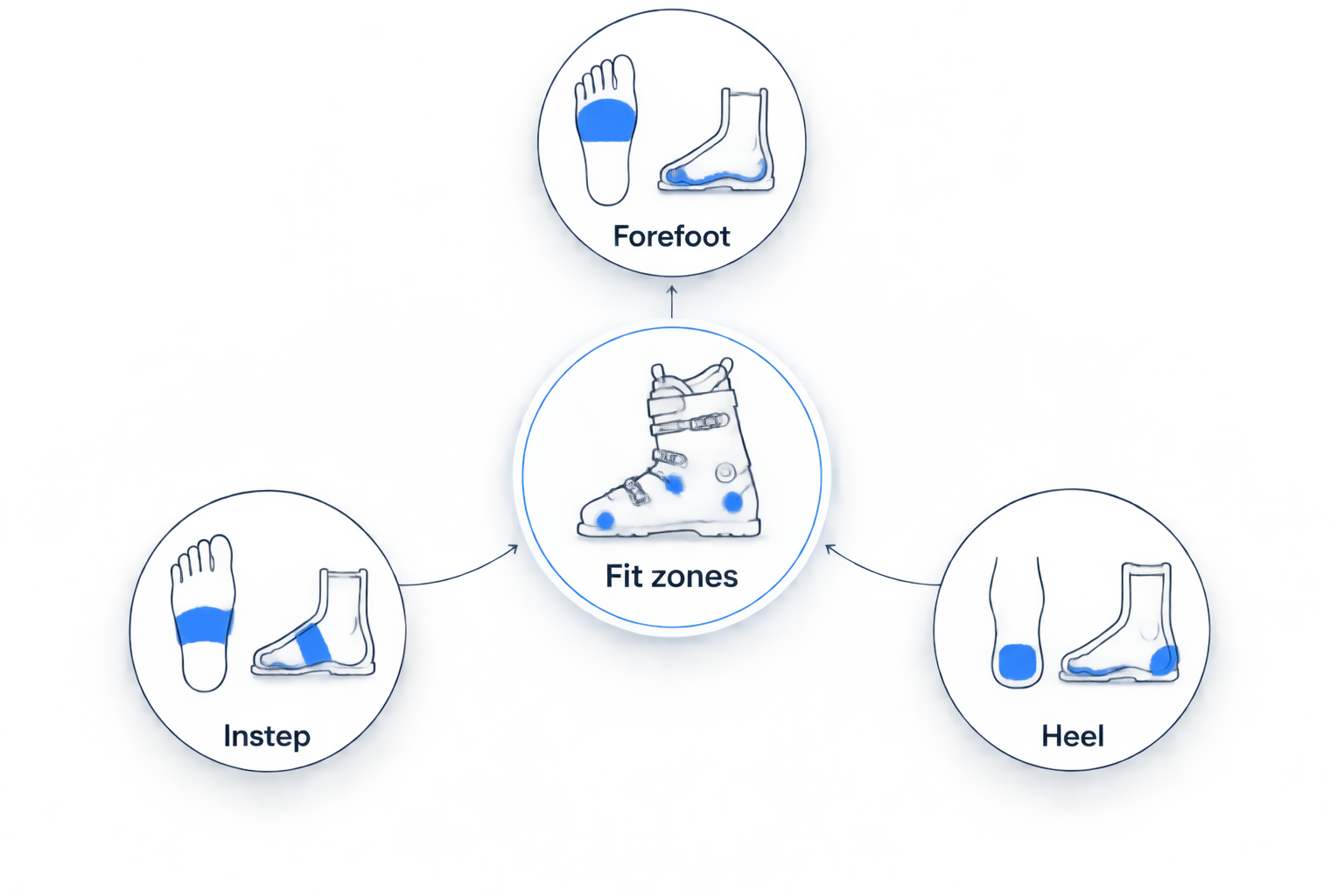
Check the shape before deciding that every part of the boot needs enlarging.
- Describe forefoot squeezing separately from pressure over the instep.
- Check whether your heel moves despite tight lower closures.
- Compare the position of your ankle bones with the shell shape.
- Ask which reference size a listed last measurement describes.
3. Verify shell length before choosing a wider model
You can begin by comparing your foot measurements with the manufacturer's sizing information, but a size chart cannot show internal contact. A professional shell assessment examines your foot inside the shell without relying solely on the liner's initial softness.
Skiboulder is best for Boulder skiers who want ski boot fitting alongside rentals, tuning, and retail gear. Bring your current boots and explain the pressure pattern rather than asking only for the widest replacement.
Skiboulder ski boot fitting gives you an in-person setting to discuss fit. The limitation is that a shop assessment cannot reproduce every on-snow load or temperature; describe what happens while skiing as well as what you feel indoors.
For a 2026 replacement, do not assume your previous size remains the correct starting point across different models.
- Bring your current shells, liners, and footbeds.
- Ask the fitter to assess shell length and shape separately.
- Explain your terrain, skiing ability, and typical stance.
- Compare shell fit before judging liner cushioning.
- Confirm what further assessment or follow-up the fitting requires.
4. Test retention without overtightening closures
Wear 1 pair of thin ski socks for a consistent comparison. Extra sock layers change the fitting conditions and can add wrinkles or pressure. Seat your heel, close the boot as intended, then flex forward in a balanced skiing stance.
A good assessment considers both pressure and movement. A boot that feels spacious while standing still can allow your foot to shift under load. Conversely, tightening a lower closure harder does not correct a shell that is fundamentally the wrong shape.
Compare closure systems by how they distribute pressure on your foot, not by assuming one mechanism solves wide feet. Shell shape still matters. Record whether the heel stays seated without crushing the instep.
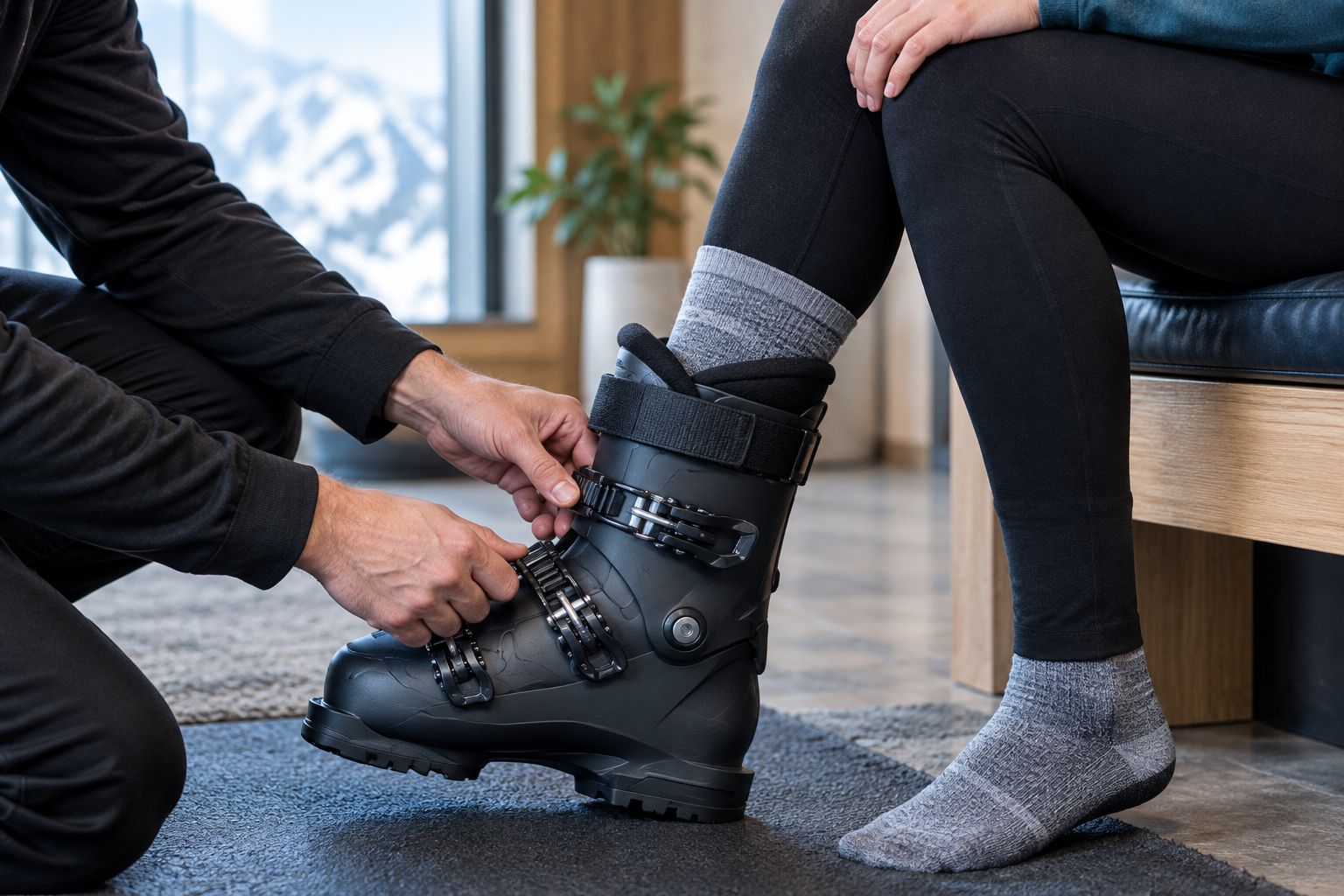
Repeat the same movements in each candidate so the comparison stays meaningful.
- Bring the socks you actually intend to ski in.
- Compare left and right feet rather than assuming symmetry.
- Flex forward and check whether your heel remains seated.
- Identify which closure introduces pressure over the instep.
- Reject the idea that numbness is a necessary break-in stage.
5. Match the adjustment to the actual contact point
Before changing equipment, check simple causes such as folded socks, a displaced liner tongue, or a footbed that is not seated correctly. Those checks do not require modifying a shell. They also help separate a setup problem from a shape mismatch.
A fitter can then assess whether liner work, footbed changes, or shell modification suits the problem. Heat molding is not a substitute for selecting an appropriate shell. Materials and manufacturer instructions determine what can be changed; not every liner or shell supports the same process.
Skiboulder offers boot fitting, but ask which procedures apply to your particular boot rather than assuming every modification is included. For your 2026 fitting, describe the intended result: less pressure at one joint, for example, without losing heel retention.
- Check the liner tongue and sock position first.
- Identify whether pressure is localized or spread across the whole foot.
- Ask what material or component would be changed.
- Confirm whether the proposed work suits the manufacturer's instructions.
- Reassess retention after any adjustment that creates more space.
6. Assess foot support without assuming every wide foot needs orthotics
Start by checking that your existing footbeds sit flat and match the liners. Bring any prescribed devices you already use. Their shape changes how your foot sits inside the boot, including the space above the instep.
Foot support and shell width solve different problems. Support can change how your foot is positioned, but it does not turn an unsuitable shell into a suitable one. Adding material beneath your foot can also reduce vertical space, which matters when your instep already feels compressed.
Choosing custom orthotics for flat feet is a separate clinical decision from choosing a wider ski boot; neither a width label nor foot shape alone establishes that you need a prescribed device. Persistent pain, altered sensation, or symptoms outside ski boots call for assessment by a qualified healthcare professional.
- Bring the footbeds or orthotics you currently ski with.
- Explain any diagnosed foot conditions to the fitter.
- Recheck instep pressure after changing support beneath the foot.
- Keep clinical assessment separate from equipment modification.
- Avoid stacking inserts to fill space without assessing the whole fit.
7. Recheck the complete ski setup after a boot change
Record the new boot's sole information and bring your skis when the binding assessment requires them. A matching printed boot size does not establish matching boot sole length or binding compatibility. Have a qualified technician confirm the boot-binding combination and required adjustment or testing.
The binding adjustment with torque test service is relevant to that conversation. Confirm the scope for your equipment rather than assuming a boot fitting automatically includes binding work.
Do not diagnose every on-snow problem through your boots. Poor edge condition, base damage, and an unsuitable ski can complicate feedback about control. Equally, sharper edges will not correct a foot moving inside an oversized shell. Change one variable at a time when practical.
- Have a technician check boot-binding compatibility.
- Confirm adjustment and testing requirements after changing boots.
- Inspect ski edges and bases separately from boot fit.
- Keep notes about pressure, heel movement, terrain, and snow.
- Report recurring symptoms before making further equipment changes.
Compare fitting options for wide-footed skiers
For 2026, compare approaches by the problem they address, not by how much room they promise. Start with shape; use adjustments to refine a suitable foundation. The options below are not interchangeable, and none guarantees a pain-free result.
| Option | Best for | Main benefit | Key limitation |
|---|---|---|---|
| Wider or higher-volume shell | Broad pressure caused by a shape mismatch | Changes the starting interior shape | Extra room can also reduce heel retention |
| Liner assessment or molding | A suitable shell with liner-related pressure | Addresses the interface around the foot | Cannot reliably compensate for an unsuitable shell |
| Localized shell modification | An isolated contact point in an otherwise suitable boot | Targets a specific pressure area | Suitability depends on shell material and construction |
| Footbed assessment | Reviewing support and foot position inside the boot | Considers how the foot sits under load | Added thickness can reduce instep space |
| Rental or seasonal lease fitting | Skiers choosing equipment for a trip or winter | Allows fit to be assessed within the rental selection | Do not assume modifications, exchanges, or particular models are included |
| Retail boot fitting | Skiers selecting their own boots | Supports comparison around individual fit needs | Indoor comfort alone does not establish on-snow suitability |
If you rent or lease, report pressure before leaving with the equipment. Ask what is included and how fit concerns are handled; do not assume the same arrangements apply to daily rentals, seasonal leases, and retail boots.
Common mistakes wide-footed skiers make
Choosing extra length to create width
A longer shell changes heel and ankle positioning as well as toe space. Compare shapes before increasing length. If length is already appropriate, describe the exact side pressure instead of asking for the next size automatically.
Treating a high instep as a wide forefoot
Pressure over the top of your foot is not the same as squeezing across the toe joints. A wider model can still press down on a high instep. Ask for both dimensions to be assessed, then check heel hold again.
Using maximum closure tension to hold the heel
A loose heel combined with a crushed instep points to a fit problem, not a need for more force. Reset the closures and show the fitter what moves. Stronger tightening does not reshape the heel pocket around your anatomy.
Expecting every pressure point to disappear with use
Liners change with use, but that does not justify skiing through sharp pain or loss of sensation. Distinguish general snugness from a repeatable focal problem. Record the location and seek an assessment rather than waiting for severe symptoms to resolve themselves.
Replacing skis before isolating the fit problem
An unstable foot can make a ski feel difficult to control, while dull edges can make a well-fitted setup feel uncertain on firm snow. Assess boots, bindings, and ski condition separately. Buying different skis is not a diagnosis.
FAQ
What's the best ski boot fit for wide feet?
The best fit provides forefoot room while retaining your heel and matching your instep height. Compare shell shape and length in person rather than selecting solely by a wide-fit label.
Are wide feet and high-volume feet the same thing?
No, wide feet and high-volume feet describe different fitting needs. A wide forefoot does not establish instep height, heel width, or the amount of space needed around the ankle.
Should I size up my ski boots if my feet are wide?
Do not automatically size up ski boots to accommodate width. Assess shell length first, then compare shapes that provide appropriate forefoot space without unnecessary heel movement.
Can heat molding make any ski boot fit wide feet?
No, heat molding cannot make every ski boot suitable for wide feet. The result depends on the starting fit, materials, and manufacturer-approved process, so assess shell suitability first.
Is numbness normal when breaking in ski boots?
Persistent numbness is a reason to stop and reassess, not a fitting goal. Relieve the pressure and seek professional assessment; persistent or recurring altered sensation also warrants medical attention.
Can I get a good fit with rental or seasonal lease boots?
Rental and seasonal lease boots still need assessment for length, width, instep space, and heel retention. Explain pressure before leaving and confirm how the provider handles fit concerns without assuming particular modifications or exchanges.
Do I need a binding check after changing ski boots?
Have a qualified technician assess your bindings after changing ski boots. Printed boot size alone does not confirm matching sole length, sole compatibility, or correct binding adjustment.
One last thing
Bring the uncomfortable boot, not just a description of your foot. Its liner, footbed, shell shape, and closure settings provide concrete evidence of what you have been skiing in. For your next Skiboulder ski boot fitting, bring 1 pair of ski socks and your existing footbeds, then explain both the pressure location and any unwanted movement.
Related guides
NEED A TUNE OR A FRESH SETUP?
– BETTER SKIING

- Professional Wintersteiger base grinds
- Precision edge sharpening
- Phantom Glide treatments
- Full binding safety checks
BOOK YOUR TUNE

KEEP YOUR GEAR
MOUNTAIN-READY
Keep your gear running
smooth — bring it to the experts.
0 comments