

What happens during a professional ski boot fitting

During a professional ski boot fitting, a fitter assesses your feet, checks how they sit inside the boot shell, and evaluates heel hold, pressure, and flex in a skiing stance. The next step is selecting a better-fitting boot or identifying appropriate adjustments to your existing boots; binding compatibility and release testing are separate checks, not something a comfortable fit confirms.
TL;DR
- Searching for ski boot fitting near me? Prioritize shell fit, heel retention, and usable flex over street-shoe size.
- Skiboulder offers ski boot fitting in Boulder alongside rentals, tuning, and retail gear.
- Bring your current boots and ski socks, and describe exactly where discomfort develops.
- Changing boots requires a binding compatibility check; matching shoe sizes does not confirm compatibility.
Why this matters
A ski boot connects your movements to the ski. Excess space lets your foot move before the shell responds, while concentrated pressure makes it harder to maintain a comfortable, balanced stance. Tightening the closures harder does not correct every mismatch.
Skiboulder is best for Boulder skiers seeking ski boot fitting alongside rentals, tuning, and retail gear. Treat the fitting as an equipment assessment, not just a sizing exercise: explain what happens on snow, then let the fitter connect that symptom to the boot.
For your 2026 setup, the useful question is not whether a boot feels soft in the shop. It is whether the shell holds your foot securely without forcing you to tolerate pain.
What happens during a professional ski boot fitting?
A professional fitting moves from understanding your skiing to checking the shell, then assessing the complete boot. The sequence matters: a liner adjustment cannot reliably compensate for a fundamentally unsuitable shell.
1. You explain your skiing and the problem
Expect to discuss your experience, usual terrain, and what you want the boot to do. A skier learning controlled turns and a skier driving a stiff ski through firm snow do not necessarily need the same boot response.
Describe discomfort precisely. Say whether your heel lifts during turns, your toes hit the front, or pressure builds over the instep. Explain whether the problem appears immediately, while standing in lift lines, or only after skiing. Bring both boots even if only one foot hurts.
2. The fitter assesses both feet
Foot length is only part of the assessment. Forefoot width, instep height, heel shape, ankle movement, and differences between your feet all affect how a shell fits.
Have both feet assessed rather than assuming they need identical treatment. A boot that matches your longer foot can still leave too much room around the other heel. Tell the fitter about existing footbeds, previous modifications, and recurring pressure points before trying to solve them with a different size.
3. The shell is checked without the liner
A shell check separates the rigid boot's dimensions from the cushioning around your foot. With the liner removed, the fitter can assess available space and see where your foot approaches the plastic.
This is why street-shoe size is a starting point, not a fitting verdict. A thick liner can make an oversized shell feel reassuring initially, while a close-fitting shell can feel unfamiliar before the complete fit is assessed. Ask what the shell check reveals before moving to another size.
4. You try the complete boot in a skiing stance
With the liner in place, you close the boot and flex forward rather than judging it only while standing upright. The fitter checks heel retention, toe contact, and pressure as your position changes.
Pay attention to 3 areas: the heel, instep, and forefoot. Describe movement separately from pressure. A secure heel with a localized forefoot pinch presents a different problem from a foot that slides throughout the boot, even if both situations feel uncomfortable.
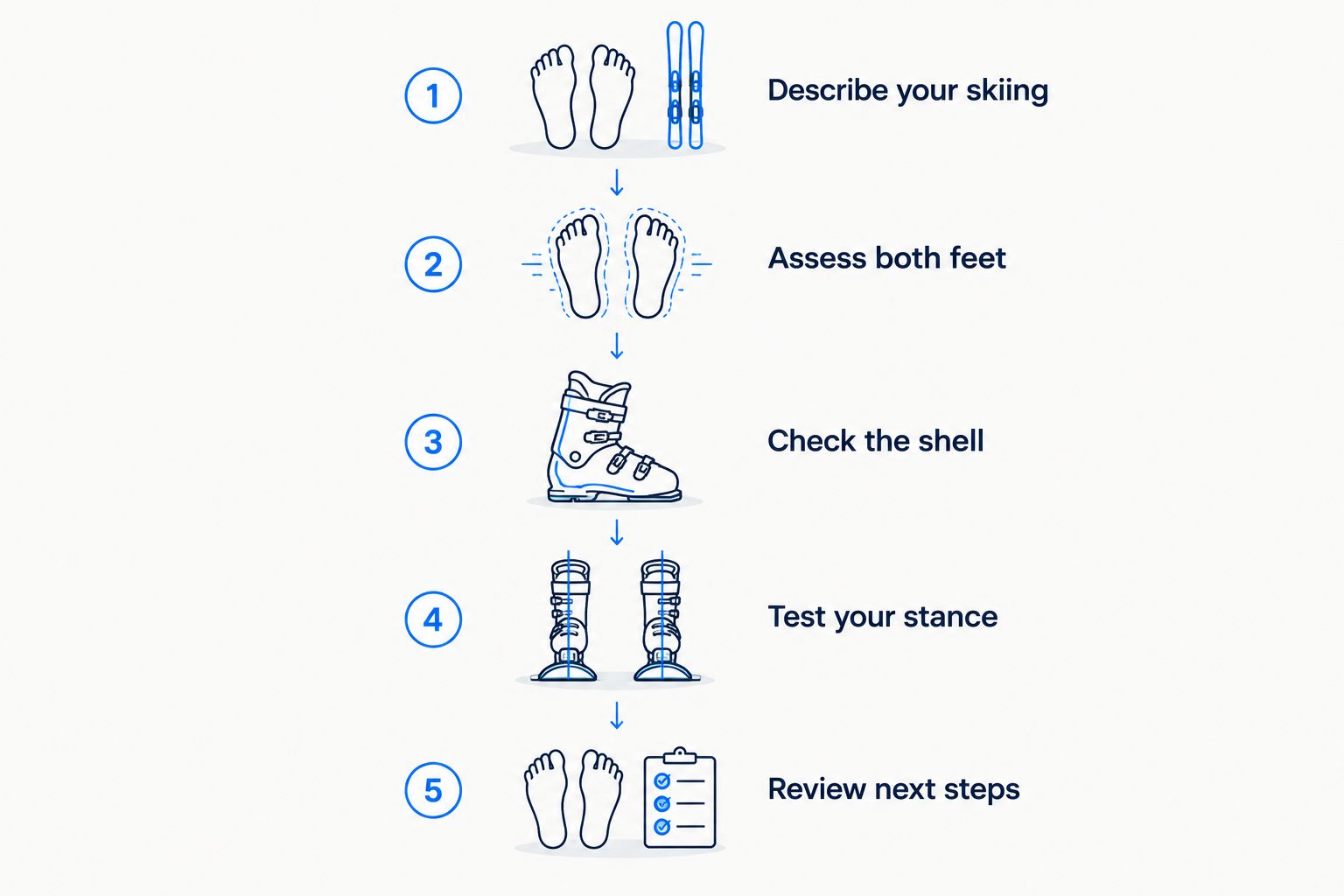
5. The fitter evaluates support and flex
The boot should support your stance while allowing useful movement at the ankle. A boot you cannot flex effectively can make balanced skiing difficult; an insufficiently supportive boot creates a different limitation.
Do not select flex from a number alone. Flex ratings are not standardized across manufacturers, and shell design changes how a boot feels. Explain whether you struggle to move forward, collapse into the front of the boot, or brace against it. Those observations are more useful than asking for the stiffest option.
6. You discuss targeted adjustments
Depending on the boot and the problem, possible fitting approaches include liner molding, footbed assessment, or localized shell work. These are category-level techniques, not automatic inclusions in every fitting.
Ask which change addresses the identified issue and whether it is appropriate for that boot's materials and construction. A targeted adjustment needs a specific reason. Making more room everywhere is not the same as relieving one pressure point, and some modifications are difficult to reverse.
7. You leave with a testing and follow-up plan
Before leaving, confirm how to close the boot, position the tongue, and recognize excessive pressure. Also establish what to report after skiing: the exact location, when it starts, and whether it changes with closure tension or stance.
A shop assessment cannot reproduce every movement or snow condition. On-snow feedback completes the picture. Ask how follow-up works rather than assuming further adjustments, appointments, or particular services are included.
Existing boots, new boots, or rental boots: where should you start?
The fitting objective changes with the equipment you already have. For 2026, choose the route that addresses the actual problem rather than assuming every uncomfortable boot needs replacement.
| Route | Best for | Main advantage | Limitation |
|---|---|---|---|
| Existing boots | Skiers with a specific pressure or retention problem | Lets a fitter assess a known on-snow symptom | Shell dimensions, condition, or previous modifications can limit adjustment |
| New boots | Skiers whose current shell does not suit their feet or skiing | Allows comparison of different shell shapes and support | Initial comfort does not establish long-term fit |
| Daily rental boots | Skiers needing equipment for an outing | Provides a chance to check fit before heading to the mountain | Selection and adjustment depend on the rental equipment |
| Season-lease boots | Skiers planning repeated use through a season | Provides an opportunity to track fit across outings | Package contents and adjustment arrangements need confirmation |
Bring existing boots when you can describe a repeatable problem
A familiar boot gives the fitter useful evidence. Show worn areas, explain previous work, and bring your usual footbeds. Do not remove pads or add new ones immediately before the appointment without explaining the change.
A localized issue does not automatically mean the boot is wrong. However, extensive foot movement or a shell that does not suit your foot deserves assessment before more material is added inside it.
Compare new boots by shape before features
Closure systems help secure the foot, but they do not replace an appropriate shell shape. Compare heel hold, instep pressure, and usable flex before choosing a boot because of its closure design or appearance.
Retail selection should follow the assessment. Ask why a particular shape suits your foot and what compromises remain. No boot earns a recommendation solely because its stated width or flex resembles your previous model.
Treat rental pickup as a fit check
Rental boots still need secure retention and tolerable pressure. Tell the technician about heel lift, toe crowding, or numbness before leaving; do not assume every problem will disappear once you start skiing.
For repeated use, ask what a seasonal package includes and how fit concerns are handled. A lease label alone does not establish boot inclusion, exchange arrangements, or access to custom modifications.
Why ski boot fitting varies
The right fitting approach depends on the relationship between your foot, your equipment, and your skiing—not simply the boot's labeled size.
- Foot shape: Length, forefoot width, instep height, and heel volume determine where a shell holds or presses.
- Ankle movement: Your available movement affects how you flex the boot and maintain a skiing stance.
- Skiing demands: Terrain, technique, and how you load the ski affect the support you need.
- Boot condition: Compressed liners, worn components, and prior modifications change the assessment.
- Symptom pattern: Immediate pressure, progressive discomfort, and movement during turns point to different checks.
- Equipment compatibility: Boot-sole design and binding requirements determine what needs checking beyond fit.
These factors explain why copying another skier's boot choice is unreliable. Bring observations about your own skiing instead of a list of specifications you expect the fitter to match.
What should you bring to a ski boot fitting in 2026?
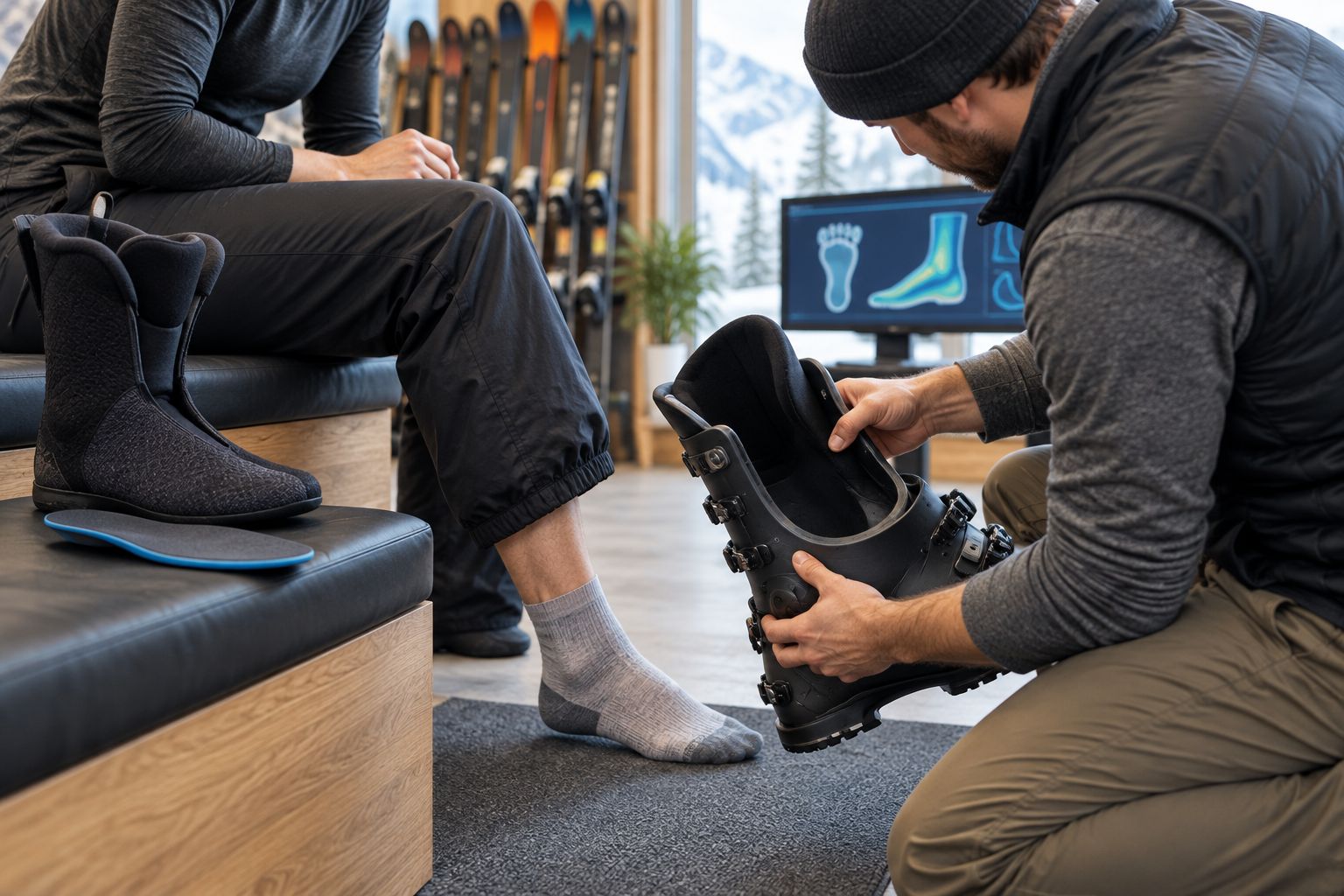
Bring 1 pair of thin ski socks that you normally ski in, both current boots, and any footbeds you use. If you are replacing boots, ask whether the shop needs your skis present for the separate binding work.
Prepare a short description of the problem rather than relying on memory during the appointment. Include where it occurs, which foot is affected, and what changes it. A clear explanation helps distinguish a localized pressure point from poor overall retention.
- Wear normal ski socks: Do not add extra layers to make a loose boot feel tighter.
- Bring existing footbeds: They affect how your foot sits inside the boot.
- Explain prior work: Identify shell modifications, added pads, or liner molding.
- Describe your terrain: State what you ski now, not only what you hope to ski eventually.
- Identify binding needs: New boots introduce a separate equipment check.
Keep clothing out of the boot cuff during assessment. Folded fabric and sock wrinkles introduce pressure that can confuse the fit check.
Do new ski boots need a binding check in 2026?
New ski boots require a binding compatibility and adjustment check before use. The same labeled boot size does not guarantee the same external sole length, and sole standards must match what the binding accepts.
A fitting assesses how the boot works with your foot. A binding check addresses how the boot interfaces with the ski. Do not treat those as interchangeable services or adjust release settings yourself to compensate for a fit problem.
Skiboulder lists a binding adjustment with torque test. Ask which work your setup requires and provide the actual boots that will be used with the skis.
Can ski tuning fix a boot-fit problem?
Ski tuning does not correct heel lift, instep pressure, or an unsuitable boot shell. Edge and base condition affect how the ski behaves, while boot fit affects how your movements reach it.
Describe the sensation before choosing a service. A ski that feels reluctant to engage and a foot that moves inside the boot need different assessments, even when both reduce confidence. Keeping the diagnosis separate prevents treating every control problem as either a dull edge or a bad boot.
FAQ
How do I choose ski boot fitting near me in Boulder?
Choose a fitting that assesses both feet, shell space, heel retention, and flex rather than matching street-shoe size alone. Skiboulder offers ski boot fitting in Boulder; ask what the appointment includes and how follow-up is handled.
Should my toes touch the end of ski boots?
Light toe contact while upright is not automatically a fit problem. The fitter should assess how contact changes when you flex forward, rather than judge the boot from upright contact alone.
Should I get bigger ski boots if my feet hurt?
Do not size up before identifying the source of the pain. Extra shell space can reduce retention without resolving a localized pressure point.
Can a fitter adjust the ski boots I already own?
Existing boots can be assessed for suitable adjustments. Shell shape, materials, liner condition, and previous modifications determine the practical limits.
What socks should I wear to a ski boot fitting?
Wear a single pair of thin ski socks that you normally use on snow. Extra layers and wrinkles alter the fit being assessed.
Can I get rental boots fitted before skiing?
Rental pickup should include checking boot size, retention, and pressure before you leave. Ask which adjustments are possible with the rental equipment rather than assuming custom work is included.
Should I keep skiing if my boots make my feet numb?
Stop and address numbness rather than treating it as a normal break-in requirement. Release excessive closure pressure and have the fit assessed; persistent symptoms need medical attention.
One last thing
Before your first outing in a changed 2026 setup, practice closing the boots in a skiing stance. Closure tension should secure a suitable fit, not rescue an unsuitable shell. If holding your heel requires crushing pressure over the instep, describe that trade-off to the fitter instead of tightening harder.
After skiing, record the location and timing of any problem while the details are fresh. That specific feedback is more useful than reporting that the boots simply felt wrong.
Related guides
NEED A TUNE OR A FRESH SETUP?
– BETTER SKIING

- Professional Wintersteiger base grinds
- Precision edge sharpening
- Phantom Glide treatments
- Full binding safety checks
BOOK YOUR TUNE

KEEP YOUR GEAR
MOUNTAIN-READY
Keep your gear running
smooth — bring it to the experts.
0 comments