

Used skis for growing junior racers: complete 2026 guide

Junior racers’ ski selection is the process of matching used skis for junior racers to their size, technique, and discipline so they can train on equipment they can control. Growing racers also need boot-fit checks, binding verification, and an inspection that separates repairable wear from damage that rules a ski out.
TL;DR
- Choose used skis for junior racers by current fit, structural condition, and binding compatibility—not room to grow.
- Skiboulder suits Boulder families seeking ski selection, boot fitting, and tuning in one shop.
- Compare seasonal leases with ownership, but confirm that any lease equipment matches the coach’s requirements.
- Have a technician inspect used race skis before mounting, adjusting bindings, or changing edge angles.
Why ski selection matters for junior racers
A growing racer presents two separate equipment questions: does the setup fit today, and does it support the skiing the coach is teaching? A longer ski does not solve both. Neither does a race label.
For your 2026 equipment decision, start with the training discipline, current boots, and coach’s recommendation. Then assess each used pair individually. Two skis bearing the same model name can have different mounting histories, edge wear, and repair needs.
General guidance on used skis for Colorado conditions helps frame terrain choices, but a junior race setup also needs discipline-specific sizing and a serviceable boot-binding combination.
Choose equipment for the racer standing in front of you, not the racer you expect next winter. Growth is a reason to reassess equipment, not a reason to accept poor control now.
How to choose used skis for a growing junior racer
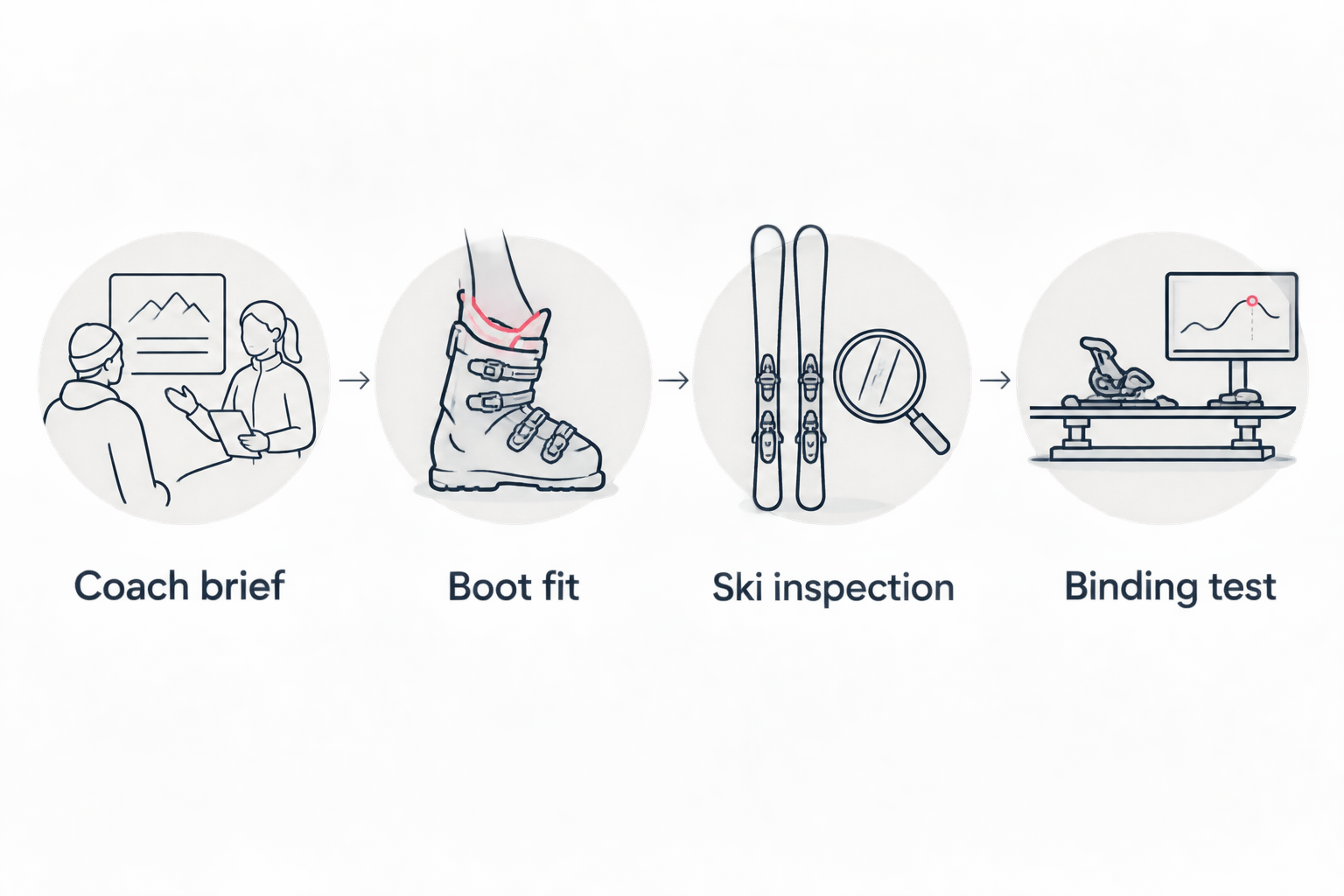
Get the coach’s equipment brief
Ask the coach what the skier needs before you review listings or accept a teammate’s hand-me-downs. Slalom and giant slalom place different demands on ski length and turn shape. Recreational training and competition requirements are not interchangeable either.
Write down the intended use in plain language. A child learning to balance through a turn needs a different discussion from a racer whose coach has requested separate discipline-specific skis. Confirm the applicable 2026 program and competition requirements rather than relying on an older listing’s description.
The coach’s brief should narrow your search without pretending to replace a physical inspection. A suitable model can still be an unsuitable used pair.
- Record the racer’s current height, weight, and skiing experience.
- Ask whether the setup is for slalom, giant slalom, or general training.
- Request guidance on length and flex appropriate to the skier.
- Confirm the rules that apply to the intended events.
Check boot fit before judging ski fit
Start at home by noting pressure points, heel movement, and complaints from the previous session. Bring the actual boots to any equipment assessment. A remembered shoe size is not enough to evaluate a binding setup.
Boot sole length, marked in millimeters, is different from the boot’s size designation. A replacement boot can change the binding adjustment required, even when the child’s stated boot size appears similar. Sole type matters too: the boot and binding must be compatible.
Do not ask a child to tolerate oversized boots to extend their useful life. Excess movement makes it harder to transmit movements consistently. A boot-fitting assessment can help distinguish a fit problem from a ski problem before you change equipment.
- Record the boot model and marked boot sole length.
- Bring the socks the racer normally wears while skiing.
- Describe heel lift, numbness, pressure, or excessive movement.
- Recheck compatibility whenever the boots change.
Inspect the used skis and verify the bindings
Begin with a visual inspection in good light. Compare both skis, looking for edge separation, exposed core material, cracks, and distortion. Photograph suspicious areas for discussion, but do not treat photographs as a substitute for a hands-on assessment.
Scratches alone do not establish whether a ski is suitable. Damage beside an edge, thin edges after repeated tuning, or a questionable mounting area deserves closer attention. Ask about previous repairs and mounts; an unknown history needs inspection, not reassurance from a seller.
Skiboulder is best for Boulder families who want junior ski selection, boot fitting, and tuning assessed together. Bring the skis and boots so the discussion concerns the complete setup. For an existing mount, ask whether a binding adjustment with torque test is appropriate; adjustment cannot resolve every compatibility or mounting problem.
- Compare the skis for visible distortion or mismatched condition.
- Inspect bases, edges, sidewalls, and mounting areas.
- Disclose known repairs, previous mounts, and missing history.
- Have a technician determine compatibility and required binding work.
Establish the tune instead of guessing
First, collect whatever maintenance information accompanies the skis. Ask what edge angles were used, whether the bases were ground, and where repairs were made. Treat those answers as history to verify, not instructions to copy automatically.
Base bevel and side bevel describe different surfaces of the edge. A 1° base bevel is not the same adjustment as a 2° side bevel; a 3° side bevel is another distinct specification. These are examples of angle notation, not recommended settings for every junior racer. Ask the coach and technician to agree on a suitable setup.
A World Cup Race Tune is a service to discuss with Skiboulder, not a reason to assume every used pair needs the same work. Confirm the requested preparation and have structural or base damage assessed first. Tuning cannot make an unsuitable ski fit the racer.
- Bring the coach’s edge-angle guidance to the service discussion.
- Identify visible rust, burrs, base damage, and previous repairs.
- Ask the technician to assess remaining edge and base material.
- Record the confirmed tune specifications for future maintenance.
Compare ownership with a seasonal setup
Create a simple equipment record before choosing a route: current boots, coach-approved ski requirements, and the intended training schedule. That record lets you compare used ownership, new equipment, and seasonal arrangements against the same needs.
Ownership gives you continuity with a particular pair, but you remain responsible for monitoring fit, wear, and service. A seasonal arrangement provides another way to equip a growing skier, but the word junior does not establish that the skis suit gate training.
For a 2026 seasonal arrangement, ask about equipment type, fitting, maintenance responsibilities, and what happens when fit changes. Do not assume that a rental or lease includes race-specific skis, repairs, exchanges, or additional pairs. Get the actual terms before making the equipment decision.
- Compare each option against the coach’s written brief.
- Confirm which skis, boots, and bindings are included.
- Ask how fit changes and equipment concerns are handled.
- Establish who handles tuning, damage assessment, and binding checks.
Reassess the setup during the season
Keep a short equipment log after training. Record specific observations: heel movement, difficulty engaging an edge, a new vibration, or damage from a rock strike. A clear description is more useful than saying the skis feel wrong.
Then separate technique feedback from equipment diagnosis. Ask the coach about on-snow behavior and the technician about fit, condition, and mechanical function. Changing length, boots, and tune together makes it harder to identify what resolved a problem.
Keep the same discipline through the rest of 2026. Revisit the setup after a boot change, a significant impact, or a clear fit concern rather than assuming the original assessment remains valid indefinitely.
- Dry the skis and inspect them before storage.
- Note recurring boot discomfort and changes in control.
- Stop using equipment with suspected structural or binding damage pending inspection.
- Bring the equipment log to the next fitting or service visit.
Compare equipment routes for growing racers
The best option is the one that meets the racer’s current requirements and passes inspection. No route removes the need to check boots, bindings, ski condition, and the coach’s brief.
| Option | Best for | Main advantage | Key limitation |
|---|---|---|---|
| Used junior race skis | Families with a specific coach-approved target | Lets you assess a particular model and pair | Wear, repairs, and mounting history require individual inspection |
| New junior race skis | Racers with clearly defined equipment requirements | Removes a previous owner’s use and repair history from the decision | New equipment still needs correct sizing, compatibility checks, and preparation |
| Core Lease Package SL/GS | Families exploring a discipline-specific lease | Provides an SL/GS package to discuss with the shop | Confirm equipment, fitting, service responsibilities, and terms |
| General junior rental or seasonal lease | Young skiers whose training brief allows recreational equipment | Offers an alternative to owning a particular pair | A general junior setup is not automatically suitable for racing |
When discussing these routes with Skiboulder, bring the same information to each comparison. A lease name, a race graphic, or a new topsheet does not establish the right length, flex, or binding compatibility.
Common mistakes families of junior racers make
Choosing extra length for future growth
A ski chosen mainly for next season can be harder for the child to control now. Use the coach’s current recommendation and reassess as the racer develops. Do not treat growth allowance as the deciding specification.
Treating every junior race ski as interchangeable
Slalom and giant slalom equipment serve different turn demands. Even within a discipline, the model, length, and flex must suit the skier. Copying an older teammate’s setup skips those decisions.
Judging condition from the topsheet
Graphics and cosmetic chips do not tell you how much edge remains or whether a mounting area is sound. Inspect the working surfaces and structure. Ask a technician to assess damage that you cannot confidently identify.
Assuming an existing binding setup transfers unchanged
A binding adjusted for the previous skier is not ready simply because the new boot clicks in. The actual boot, skier information, compatibility, and mechanical function need checking. Leave release-setting decisions and testing to a qualified technician.
Asking for an aggressive tune without a reason
A more acute side-edge angle is not an automatic improvement for every developing racer. Follow a coordinated plan between the coach and technician. Repeatedly changing specifications also makes equipment feedback harder to interpret.
FAQ
What should I check first when choosing used skis for junior racers?
Start with the coach’s discipline, length, and flex guidance, then check the racer’s current boots. Inspect the individual skis and have a technician assess binding compatibility and required work before use.
Should I choose longer race skis so my child can grow into them?
Choose skis for the child’s current size, technique, and training requirements rather than future growth. Ask the coach to confirm the length and reassess when the skier’s needs change.
Are used junior race skis better than a seasonal lease?
Neither route is automatically better; the equipment must meet the racer’s current requirements. Used skis need an individual condition assessment, while a seasonal lease requires confirmation of equipment type, fit, and responsibilities.
Can my child use the bindings already mounted on used skis?
A technician must assess the existing bindings with the child’s actual boots before use. Compatibility, adjustment range, mounting condition, and mechanical function determine the required work.
What edge angles should a junior racer use?
Use edge specifications agreed by the coach and technician for that racer’s equipment and training. Base bevel and side bevel are separate measurements, so record both rather than requesting a vague race tune.
When should used junior race skis be ruled out?
Rule out a pair when professional inspection identifies damage, wear, or compatibility problems that make it unsuitable for the intended use. Do not ski a pair with suspected structural or binding damage while waiting for that assessment.
What should I bring to Skiboulder for a junior equipment assessment?
Bring the racer, current boots, any skis under consideration, and the coach’s equipment guidance. Include known repair and mounting history, plus specific notes about fit or on-snow problems.
One last thing
The boot your child will actually ski in is essential to the used-ski decision. A suitable-looking ski can still require different binding work once the real boot is present. For your 2026 assessment, bring the equipment together and resolve compatibility before focusing on edge preparation.
Related guides
NEED A TUNE OR A FRESH SETUP?
– BETTER SKIING

- Professional Wintersteiger base grinds
- Precision edge sharpening
- Phantom Glide treatments
- Full binding safety checks
BOOK YOUR TUNE

KEEP YOUR GEAR
MOUNTAIN-READY
Keep your gear running
smooth — bring it to the experts.
0 comments