

SkiEssentials.com alternatives for custom boot fitting

SkiEssentials.com is a strong starting point for ski reviews and online gear research. Online comparisons stop short of showing how a boot holds your heel, matches your instep, or supports your stance in person. The best SkiEssentials.com alternative in 2026 is Skiboulder if you need boot fitting in Boulder; an independent boot fitter near home is the better route if returning locally matters most.
TL;DR
- For skiessentials.com alternatives, choose Skiboulder for in-person boot fitting in Boulder.
- Keep SkiEssentials.com in your research process; assess shell shape and heel hold in person.
- An existing-boot assessment helps distinguish an adjustment problem from a replacement decision.
- Rental fitting serves temporary equipment needs; it does not replace a personal boot-fitting assessment.
Why this matters
A ski boot connects your movements to the ski. A shell that leaves your foot moving inside it undermines control; pressure concentrated over one area can make an otherwise suitable boot difficult to wear.
The useful comparison in 2026 is not simply one retailer against another. It is online research versus a hands-on fitting process, followed by the practical question of where you can return when an on-snow problem needs attention.
You do not need to abandon a good research source. You need to separate learning about equipment from determining whether that equipment fits your feet.
SkiEssentials.com alternatives at a glance
These options serve different needs. The comparison below treats SkiEssentials.com as an online research and shopping route, not as a claim about every service associated with the business.
| Option | Best for | Standout feature or approach | Difference from online shopping |
|---|---|---|---|
| SkiEssentials.com | Researching skis and comparing equipment | Ski reviews and online product information | Helps narrow choices without physically assessing your feet |
| Skiboulder | Boulder skiers seeking hands-on boot fitting | Boot fitting alongside retail, rentals, and tuning | Brings your feet and equipment into the assessment |
| Independent boot fitter near home | Skiers who need convenient return visits | Local, in-person assessment | Lets you discuss fit symptoms with the boots present |
| Rental fitting | Skiers choosing temporary equipment | Matching rental equipment to the skier | Addresses the fit of a rental setup rather than selecting personal boots |
Use this table to choose a process, not to declare that one business handles every situation better. A skier researching ski construction and a skier with persistent heel movement need different next steps.
1. Skiboulder: best for boot fitting in Boulder
Skiboulder offers ski boot fitting, retail skis, boots and bindings, tuning, and rentals in Boulder. That makes it a relevant alternative when your search has moved beyond model comparisons to how your equipment fits and performs.
Best for: Local skiers who want an in-person boot assessment and a shop that also handles other parts of their ski setup.
Where Skiboulder shines
- Boot fitting is an explicitly offered service, rather than an assumption based on a retailer's boot selection.
- Retail boots and bindings make fit and equipment selection part of the same conversation.
- Tuning and rentals address needs beyond buying personal equipment.
Where Skiboulder falls short
- A Boulder visit is a practical requirement for hands-on fitting; it is not a remote substitute for online shopping.
- A service list alone does not establish which modification suits your foot. Discuss the actual problem before choosing a procedure.
- Choosing a local shop does not remove the need to report what happens while skiing.
| Dimension | Boulder shop route | SkiEssentials.com online route |
|---|---|---|
| Foot assessment | In-person boot fitting | Online information cannot physically assess your foot |
| Equipment context | Retail, tuning, and rentals are offered | Useful for equipment research |
| Your next step | Bring boots and describe symptoms | Narrow the questions you want answered |
For a 2026 fitting visit, bring your current boots if you have them. A fitter needs to understand whether the problem is shell shape, excess space, support, or something outside the boot itself.
Verdict: Buy only after the fit assessment supports the boot choice.
2. Independent boot fitter: best for repeat visits near home
An independent boot fitter near your home is the alternative when Boulder is not a practical place to return. Choose the individual service based on what the fitter actually assesses, not on a general promise of a custom fit.
Best for: Skiers whose main priority is convenient access to in-person assessment and follow-up.
Where a local boot fitter shines
- You can bring the boots that cause the problem rather than describe them from memory.
- The discussion can distinguish pressure in one location from excessive movement throughout the boot.
- A nearby location makes returning with specific on-snow observations more practical.
Where a local boot fitter falls short
- The label does not establish training, methods, modification options, or follow-up terms.
- A fitting-focused business does not automatically provide rentals, ski tuning, or binding work.
- Proximity alone does not establish that the fitter has assessed the cause correctly.
| Dimension | Independent boot fitter | SkiEssentials.com online route |
|---|---|---|
| Main purpose | Assess a skier's physical fit | Research and compare equipment |
| Decision evidence | Feet, stance, boots, and symptoms | Published product information |
| Selection criterion | Confirm the assessment process | Match research to your intended use |
Ask what the appointment covers and what to bring. Do not assume that footbeds, liner molding, shell work, or later adjustments are included simply because the appointment is called custom fitting.
Verdict: Hold the purchase until the fitter explains the fit problem and proposed solution.
3. Rental fitting: best for temporary equipment needs
Rental fitting is the practical route when you need equipment for a trip rather than a decision about personal boots. It belongs in this comparison because an immediate need to ski is different from a need to select your long-term setup.
Best for: Skiers who need temporary equipment and a fit check before using it.
Where rental fitting shines
- It keeps the conversation focused on the equipment you will actually use.
- You can identify obvious pressure, heel movement, and closure problems before leaving.
- It separates a short-term equipment need from a longer-term purchase decision.
Where rental fitting falls short
- Rental fitting is not the same process as selecting and modifying personal boots.
- A different rental shell does not reproduce every detail of a boot you are considering buying.
- A seasonal lease still needs an initial fit assessment; longer use does not correct a poor fit.
| Dimension | Rental fitting | SkiEssentials.com online route |
|---|---|---|
| Main goal | Fit temporary equipment | Inform equipment selection |
| Boots assessed | The rental pair you will use | Models described online |
| Limitation | Does not establish the best personal boot | Does not establish physical fit |
For your 2026 plans, distinguish daily rental needs from a seasonal lease before discussing equipment. Ask which items are included and how fit concerns are handled; do not infer those details from a package name.
Verdict: Hold the personal-boot decision if your immediate need is rental equipment.
Why people switch from SkiEssentials.com
The reasons to add an in-person alternative are specific: online product information cannot locate pressure on your foot, evaluate movement inside your boot, or physically compare your stance across shells. These are limits of the online channel, not accusations about a retailer's expertise.
Switch the next step—not necessarily your research source—when:
- Your heel moves even though you tighten the closures.
- You repeatedly experience pressure in the same place.
- You are choosing between boot shapes rather than ski categories.
- You need to discuss boots and binding compatibility together.
- You need rental fitting rather than another equipment comparison.
In 2026, the most useful reason to visit a shop remains simple: your next question requires your feet or equipment to be present.
What a useful boot-fitting assessment should answer
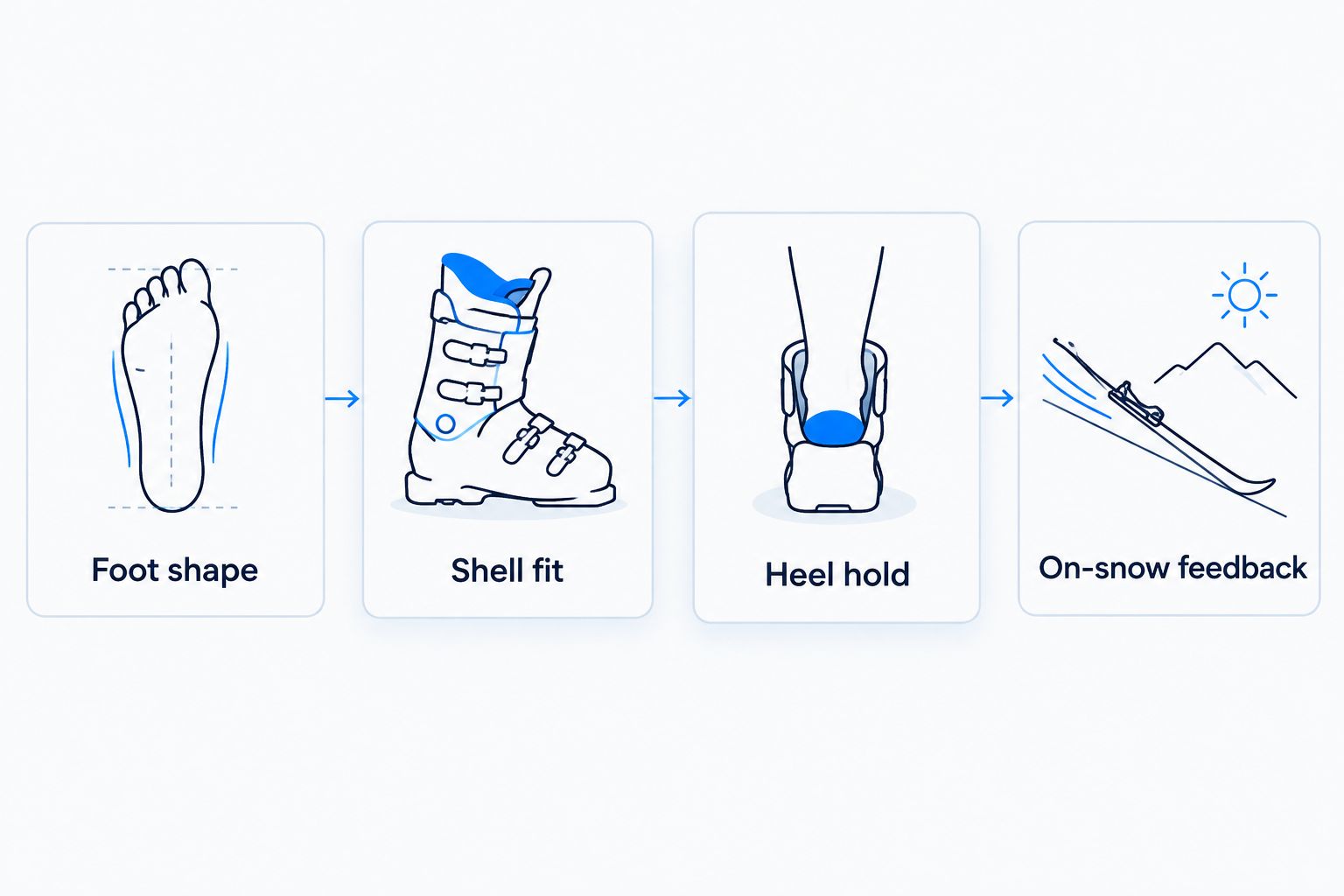
A fitting conversation should connect what you feel to what the fitter observes. The guide to what happens during a professional ski boot fitting explains the process to discuss before choosing a boot or requesting modifications.
Foot shape
Length is only part of fit. Forefoot shape, instep height, heel shape, and differences between your feet all affect how a shell holds you.
Shell fit
The liner adds cushioning and occupies space, but it cannot make every shell shape suitable. Ask the fitter to explain why the underlying shell matches your foot rather than relying only on how soft the liner feels.
Heel hold
Describe movement accurately. A heel that lifts, a foot that slides forward, and pressure over the instep are different observations, even when all three make you tighten the boot.
On-snow feedback
A shop assessment and skiing provide different information. Note where the issue appears, which movements trigger it, and whether changing closure tension affects it.
Do not interpret pain as proof that a boot simply needs more skiing. Persistent pain, numbness, or symptoms outside the boot warrant medical advice rather than repeated tightening or unplanned modifications.
Bring evidence, not just a boot size
Prepare a small amount of useful information before the appointment. Specific observations are more actionable than saying the boot feels wrong everywhere.
- Bring 1 pair of thin ski socks that you intend to ski in; avoid stacking socks to fill extra space.
- Bring 2 boots, even if only one foot hurts, so the fitter can compare the complete pair.
- Record 3 observations: the location, the activity that triggers it, and what changes the sensation.
- Bring the footbeds or prescribed devices you actually use, rather than describing their shape.
For prescribed devices, breaking in custom orthotics and assessing ski-boot fit are separate considerations. Follow the prescribing clinician's instructions, and tell the fitter what you wear; a ski-boot adjustment is not a substitute for medical assessment.
This preparation helps keep the conversation focused. A boot size written on a box cannot explain why your left heel moves or why pressure develops over your right instep.
Keep boot fit separate from tuning and binding work
Boots, bindings, and ski condition all affect your experience, but they solve different problems. Better edge grip will not correct a mismatched shell, and a different boot does not repair damaged bases.
| Symptom or decision | Relevant assessment | What not to assume |
|---|---|---|
| Heel movement or localized pressure | Boot fit | Tighter closures solve the cause |
| New boots with existing skis | Binding compatibility and adjustment | Similar-looking soles fit the same binding |
| Unpredictable edge grip | Technique and ski condition | Boot replacement is automatically required |
| Base damage | Repair assessment | Wax alone repairs structural damage |
When changing boots, ask about binding adjustment with a torque test. Compatibility and release testing are separate from deciding whether the boot feels comfortable.
For tuning, describe what the ski does on snow and show the technician any damage. Do not prescribe an edge angle or structure pattern solely because it appears in a racing discussion; the appropriate work depends on the ski, its condition, and intended use.
When staying with SkiEssentials.com makes sense
Keep SkiEssentials.com in your process when the question is about ski characteristics, model comparisons, or narrowing equipment choices before an in-person visit. Written and video research can make your questions more precise.
There is no need to replace online research with a shop visit for every question. The sensible 2026 approach is to use research for comparisons and physical assessment for fit decisions.
Stay with the research source when you need information; change the process when you need physical assessment. That distinction is more useful than declaring an entire retailer unsuitable.
FAQ
What's the best SkiEssentials.com alternative for boot fitting in Boulder?
Skiboulder is the local alternative for skiers seeking in-person boot fitting in Boulder. The shop also offers retail skis, boots and bindings, tuning, and rentals.
Is an in-person boot fitting better than buying ski boots online?
In-person fitting addresses physical fit questions that online information cannot resolve. Online research still helps you understand equipment and prepare questions before the appointment.
Should I replace my boots if my heels lift?
Have the existing boots assessed before deciding to replace them. Heel movement needs evaluation in the context of shell shape, available space, closure tension, and foot support.
What should I bring to a ski boot fitting?
Bring your current boots, thin ski socks, and the footbeds or prescribed devices you use. Describe the exact location of any pressure or movement and when it occurs.
Does custom boot fitting always mean heat molding?
No, custom boot fitting does not automatically mean heat molding. The assessment should determine whether the boot selection or any particular modification addresses the problem.
Can a rental fitting replace custom fitting for personal boots?
No, rental fitting assesses the temporary equipment you will use. Selecting personal boots requires a separate decision about shell fit, support, and intended use.
Do I need my bindings checked after changing ski boots?
Yes, have a qualified ski technician assess compatibility and the required adjustment and testing. Do not assume a new boot works correctly because it fits between the binding's toe and heel pieces.
One last thing
Do not confuse stronger closure tension with better fit. If you keep tightening a boot to stop movement, tell the fitter exactly what moves before asking for a stiffer shell or another adjustment.
The most productive fitting visit starts with a clear symptom, not a predetermined product. Bring the evidence and let the assessment determine the next move.
Related guides
NEED A TUNE OR A FRESH SETUP?
– BETTER SKIING

- Professional Wintersteiger base grinds
- Precision edge sharpening
- Phantom Glide treatments
- Full binding safety checks
BOOK YOUR TUNE

KEEP YOUR GEAR
MOUNTAIN-READY
Keep your gear running
smooth — bring it to the experts.
0 comments