

Ski binding mounting for alpine touring setups: complete 2026 guide

Alpine touring ski binding mounting is the installation and adjustment of uphill-capable bindings to match your boots, skis, and intended terrain. This 2026 guide to ski binding mounting for touring skis explains compatibility, mount position, remount checks, and transitions—because a touring setup must work while climbing as well as descending.
TL;DR
- Ski binding mounting for touring skis starts with the actual boots, binding instructions, and ski mounting requirements.
- Skiboulder is best for Boulder skiers seeking in-person binding mounting and boot-fitting guidance.
- Choose tech bindings for touring-focused use; consider hybrid bindings when resort skiing also shapes your equipment choice.
- Confirm heel clearance, boot compatibility, release procedures, and climbing transitions before taking a newly mounted setup into the backcountry.
Why binding mounting matters for alpine touring skiers
Touring bindings do more than hold a boot for downhill skiing. They also provide a pivot for climbing, heel support on ascents, and a way to switch between uphill and downhill modes. Incorrect compatibility or adjustment affects that whole system.
Your boots therefore belong at the center of the mounting decision. A walk mechanism does not prove that a boot works with a particular touring binding, and matching brand names do not establish compatibility either.
Skiboulder offers Binding Mount and Test alongside boot fitting and ski tuning. Before bringing in a touring setup, identify the exact binding model and ask whether the shop supports its mounting, adjustment, and prescribed testing procedures.
A touring binding is ready only when the ski, boot, and binding work together—not simply when the screws are installed.
How to prepare a touring setup for mounting
1. Define how you will use the skis
Start with a written equipment brief. Describe whether these skis are primarily for human-powered touring, resort skiing with occasional tours, or another specific use. Add the terrain you ski and the equipment you already own.
A touring-focused setup places different demands on climbing operation than a resort-focused setup. Neither purpose removes the need for suitable downhill performance. Be honest about your ability and how you actually ski, rather than choosing equipment around a future objective.
For your 2026 setup, separate essential functions from preferences. Uphill boot compatibility is essential; a preference for a particular climbing-riser design is a separate decision.
If your plans remain unsettled, clarify them before committing to holes in a ski. Renting or leasing resort equipment can keep resort skiing separate from your touring purchase, but a resort rental or lease must not be assumed suitable for touring.
- Record your main use: touring, resort, or mixed.
- Describe your usual terrain and skiing style.
- List the boots and skis you intend to use.
- Identify the uphill functions you need.
- Ask explicitly whether any rental or lease permits your intended use.
2. Verify the actual boots against the binding instructions
Begin with the boot model, sole markings, sole condition, and molded boot sole length. Bring both boots. A size label alone does not give a technician everything needed to set up a binding.
Tech bindings engage dedicated fittings in compatible boots. Hybrid designs combine touring functions with a different downhill interface, and their requirements vary by model. A boot having toe fittings does not establish compatibility with every touring binding or every operating mode.
Read the current instructions for the exact boot and binding before the appointment. Then use an in-person boot-fitting assessment to resolve fit problems before mounting around a boot you intend to replace.
Finalize boot fit before finalizing the mount. A different boot sole length can require readjustment or a remount, depending on the binding's adjustment range and mounting history.
- Bring 2 boots, not just one reference boot.
- Record molded boot sole length in millimeters.
- Check the manufacturer's stated boot requirements.
- Inspect soles and fittings for visible damage.
- Tell the technician about planned boot changes.
3. Match the binding type to the intended use
Start by comparing binding categories, then examine exact models. Category names explain the general approach; they do not establish a particular binding's compatibility, release behavior, or approved use.
Tech bindings use boot fittings for the touring pivot. Hybrid bindings combine different uphill and downhill mechanisms. Frame touring bindings carry the boot on a hinged frame during climbing. Each approach brings operating differences that you should understand before mounting.
Skiboulder provides an in-person route for discussing equipment, boot fit, and mounting together. Confirm support for your exact touring binding rather than treating a general mounting service as approval of every model.
For 2026 equipment comparisons, use the manufacturer's current documentation instead of assuming a familiar model name means unchanged instructions. Review brakes, ski crampons, adjustment range, and operation as a system.
- Identify the exact binding model and version.
- Compare uphill and downhill operating procedures.
- Verify the approved boot interface.
- Match brake selection to the ski and binding instructions.
- Check compatible ski crampons if your objectives require them.
4. Confirm mount position and inspect existing holes
Start with the ski manufacturer's recommended mounting reference. Discuss a different position only with a clear reason and the equipment manufacturer's guidance. A mounting preference from another ski does not automatically transfer to a touring ski.
On used skis, previous holes are part of the decision. Their position, condition, and relationship to the proposed pattern affect whether the intended mount is suitable. No universal hole-spacing rule replaces an assessment of the actual ski.
Bring the complete setup to a qualified technician before drilling. Mounting also depends on the ski's construction, the binding's specified hardware, and the correct jig or template. Guessing drill depth or substituting screws risks damaging the ski.
A remount is a separate assessment, not just a new set of holes. Tell the shop about previous mounts, repairs, inserts, or water exposure that you know about.
- Identify the recommended boot-center reference.
- Explain any requested mount-position change.
- Disclose previous mounts and repairs.
- Have existing holes and surrounding material inspected.
- Confirm that the proposed pattern is suitable before drilling.
5. Check the completed setup in every operating mode
Start with a supervised demonstration of the exact binding. The technician should explain the required adjustments and the manufacturer's prescribed checks; you should understand which checks apply to that model.
Touring bindings do not all use the same heel clearance, forward-pressure system, toe adjustment, or release procedure. Do not copy a measurement from a different binding. Likewise, a release-value scale does not mean every touring binding can be assessed with the same test procedure used for an alpine binding.
Review 3 operating states: climbing, transition, and downhill. Watch how the brake, heel unit, risers, and any mode levers behave. Ask the technician to explain the toe-locking instructions, including when the toe must be unlocked for downhill skiing.
For a 2026 handover checklist, record the binding model and where to find its instructions. Keep the setup information with your equipment records.
- Verify the model-specific heel and toe adjustments.
- Confirm the prescribed release-setting and checking procedure.
- Practice climbing, transition, and downhill operation.
- Check brake deployment and stowage as instructed.
- Ask what changes require professional readjustment.
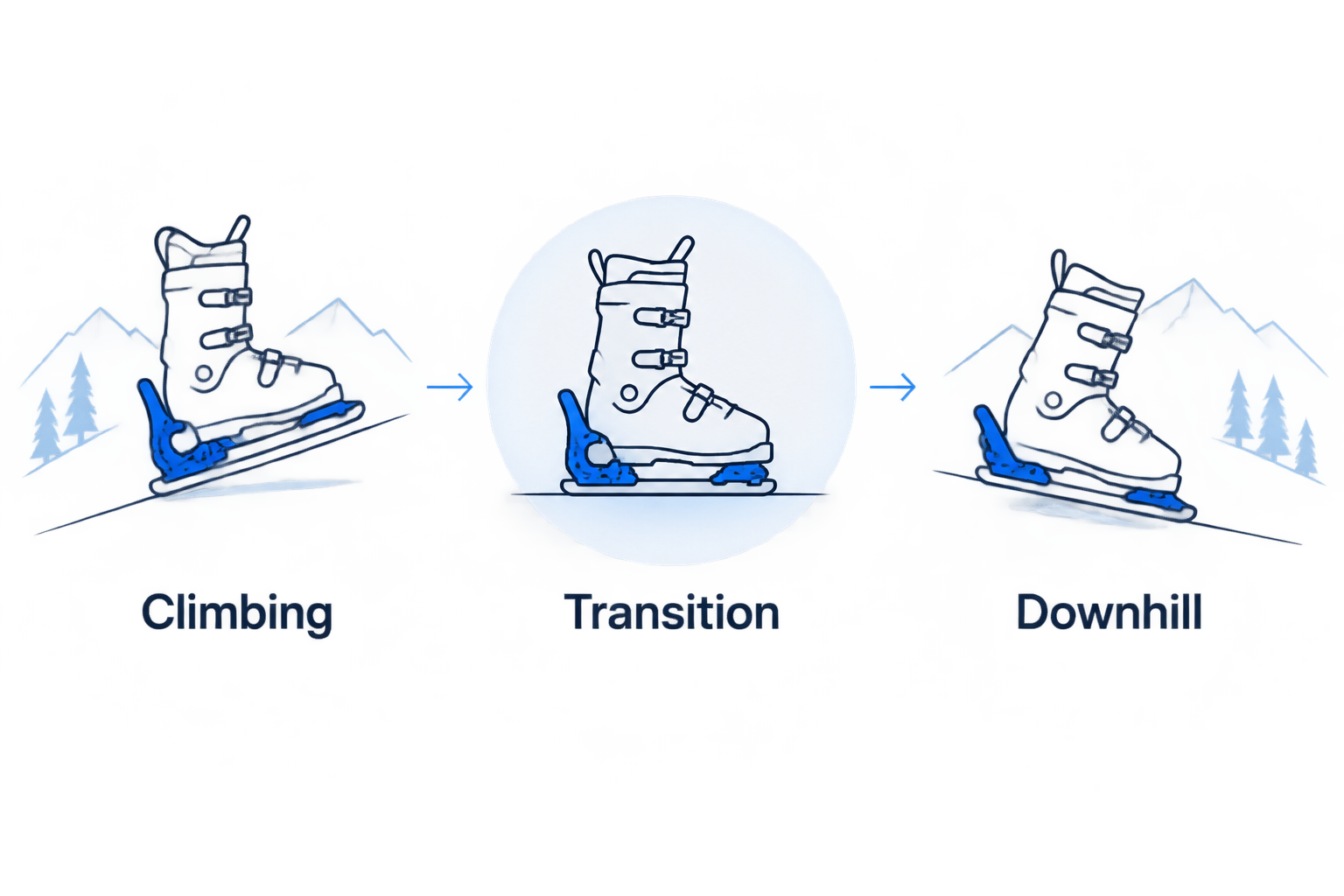
6. Practice transitions and maintain the whole system
Begin on a flat, controlled surface where you can concentrate on operation. Follow the manufacturer's instructions while practicing entry, exit, heel rotation or mode changes, and climbing-riser use. Repeat the sequence wearing the gloves you use while touring.
Before each outing, inspect the equipment and clear snow or ice from the interfaces as instructed. A boot that appears engaged is not enough: confirm proper engagement using the checks specified for your binding.
Maintenance extends beyond the mount. Damaged edges, neglected bases, skin-attachment problems, and worn boot interfaces all deserve attention. Discuss tuning and repairs separately from binding adjustment; one service does not establish the condition of the entire setup.
Stop using equipment with loose components, damaged fittings, or unexplained operating problems until it has been assessed. Do not tighten mounting screws by feel as a substitute for a diagnosis.
- Practice transitions before entering consequential terrain.
- Clear boot and binding interfaces as instructed.
- Inspect screws and components for visible movement or damage.
- Check bases, edges, skins, and attachment hardware.
- Seek inspection after an impact or unexplained malfunction.
Compare binding options for alpine touring setups
Choose by operating requirements first, then compare individual models. The table describes general categories, not a compatibility approval for any specific boot or binding.
| Option | Best for | Main advantage | Key limitation |
|---|---|---|---|
| Tech touring binding | Touring-focused skiers using approved boots with compatible fittings | A boot-fitting pivot supports uphill travel without lifting a binding frame | Boot compatibility, downhill behavior, and adjustment procedures require model-specific checks |
| Hybrid touring binding | Skiers whose equipment choice must account for both resort skiing and touring | Combines touring operation with an alpine-style downhill interface in applicable designs | Mode changes and approved boot interfaces vary; operation requires practice |
| Frame touring binding | Skiers considering a hinged-frame touring design | The frame provides the climbing pivot while retaining the boot in the binding | The frame moves during each climbing stride; boot approval still requires verification |
An ordinary alpine binding is not a touring option simply because it fits your boot. It needs a designed uphill mechanism to provide touring function.
Brakes and leashes also require a model-specific decision. Follow the binding manufacturer's requirements rather than treating either retention method as a universal substitute for the other.
Common mistakes alpine touring skiers make
Mounting before resolving boot fit
A boot that causes heel movement or pressure problems needs assessment before you organize the whole setup around it. Buying another boot afterward can change the mounting requirements. Resolve fit first; mount around the boot you intend to ski.
Treating every touring binding like an alpine binding
Touring systems use different interfaces and adjustment methods. Assuming familiar-looking scales, screws, or clearances work the same way invites errors. Use the exact binding instructions and ask which inspection and testing procedures apply.
Copying a friend's mount position
Your friend's ski construction, boot, skiing style, and mounting history are not your setup. Start at the manufacturer's reference and explain the performance issue you want to address before requesting a change.
Using a lease description as touring approval
A daily rental or seasonal lease describes an equipment arrangement, not automatic backcountry suitability. Confirm the actual equipment, permitted use, and operating instructions. Do not assume resort demo skis come with touring-capable bindings.
Treating a fresh tune as a binding inspection
Sharp edges and a waxed base do not establish boot-binding compatibility or correct adjustment. Keep tuning, structural repair, and binding inspection as distinct questions when handing over your skis.
FAQ
What's the first step in ski binding mounting for touring skis?
Confirm compatibility between your actual boots, the exact binding model, and the skis. Bring both boots and resolve fit problems before committing to a mount.
Can I use my alpine ski boots in touring bindings?
Only if the exact binding manufacturer approves those boots for the intended operating modes. A walk mechanism or a familiar sole shape does not establish compatibility, and tech bindings require compatible fittings.
Should touring bindings go on the recommended ski mounting line?
The ski manufacturer's recommended reference is the starting point. Discuss any change with a qualified technician using the ski and binding guidance rather than copying a position from another setup.
Can touring bindings be mounted on previously drilled skis?
A remount requires inspection of the existing holes, ski condition, and proposed binding pattern. A technician must assess the actual ski before deciding whether the intended mount is suitable.
Do touring bindings need the same heel gap?
No; heel-clearance and adjustment requirements depend on the exact binding. Use the manufacturer's instructions, not a measurement copied from another model.
Should I lock the toe when skiing downhill?
Follow the exact binding manufacturer's downhill instructions; do not use a touring toe lock as a general response to unwanted release. Unexpected release requires an equipment and setup assessment.
Does a ski tune include checking touring bindings?
Do not assume a tune includes a binding inspection or adjustment. Ask separately about boot compatibility, mounting condition, required adjustments, and the model's prescribed checks.
One last thing
The boot sole length matters even when the printed boot size stays the same. Two boot models labeled with the same size do not necessarily share the same external dimensions or adjustment requirements.
Before your first tour on a new 2026 setup, bring the exact boots you will use—not an older pair in the same size. Ask Skiboulder to confirm which mounting and boot-fitting services apply to your equipment, and leave with a clear explanation of the checks you must repeat yourself.
Related guides
NEED A TUNE OR A FRESH SETUP?
– BETTER SKIING

- Professional Wintersteiger base grinds
- Precision edge sharpening
- Phantom Glide treatments
- Full binding safety checks
BOOK YOUR TUNE

KEEP YOUR GEAR
MOUNTAIN-READY
Keep your gear running
smooth — bring it to the experts.
0 comments