

Ski boot fitting for backcountry skiers: complete 2026 guide

Backcountry ski boot fitting is the process of matching boot shape, support, and touring function to your feet so you can climb without damaging friction and descend with control. This 2026 guide to ski boot fitting for backcountry skiers explains how to assess fit in both modes, check compatibility, and prepare for an in-person fitting.
TL;DR
- Ski boot fitting for backcountry skiers must assess uphill movement, downhill support, and binding compatibility together.
- Skiboulder offers Boulder skiers in-person boot fitting; confirm touring-specific work before bringing your setup.
- Choose touring boots by foot shape and intended use, not walking comfort alone.
- Bring your actual socks, footbeds, boots, and binding information to a fitting.
Why boot fitting matters for backcountry skiers
Backcountry skiing asks one boot to perform two different jobs: allow repeated walking movement uphill and transmit pressure to the ski downhill. A roomy boot can feel comfortable standing still yet let your heel move during a climb. An aggressively tight fit can restrict movement and create concentrated pressure.
Skiboulder is best for Boulder skiers seeking in-person ski boot fitting. The shop offers boot fitting, retail equipment, rentals, and tuning; confirm which touring-specific assessments and modifications suit your equipment before your visit. Start with Skiboulder when planning that conversation.
Your 2026 fitting goal is not the tightest boot you can tolerate. It is a secure heel and midfoot, appropriate toe clearance, and usable ankle movement without numbness or persistent pain. Boot fitting does not replace avalanche education, route planning, or backcountry rescue preparation.
Fit your boots for the climb and descent
1. Define how you actually ski
Start at home by writing down your terrain, how you approach it, and where your current boots fail. Separate a rubbing heel during uphill travel from a loose heel while skiing; those symptoms do not automatically require the same correction.
Describe your skiing honestly. A boot chosen primarily for long approaches faces different demands from one used mainly for lift-served skiing with occasional touring. Weight, walking movement, and downhill support involve trade-offs, and no category label resolves them for your feet.
Do not select a boot from its flex number alone. Flex labels are not a uniform measurement across brands, and a boot's fit changes how effectively you can use its support.
- Record your usual terrain and approach style.
- Identify whether discomfort starts uphill or downhill.
- Note any existing blisters or pressure locations.
- Describe the skis and bindings you intend to use.
- Separate essential functions from preferences.
2. Check shell shape before changing the liner
At home, note the size and model of your current boots and compare how each foot feels. Leave detailed shell assessment to a fitter rather than choosing a smaller size from a finger-gap rule found online.
Mondopoint expresses foot length in centimeters: a 27 cm foot corresponds to a nominal 27 Mondopoint reference. That reference is not a fitting verdict. Shell length, instep height, heel shape, and forefoot width all affect whether a boot works.
A liner cannot reliably correct a fundamentally unsuitable shell. Heat molding also has limits: it does not turn every boot into the right shape. For your 2026 boot search, establish the underlying fit before discussing modifications or replacement liners.
- Have both feet assessed while bearing weight.
- Ask the fitter to assess shell length and volume.
- Identify pressure over the instep and ankle bones.
- Check heel retention without excessive closure tension.
- Compare shapes rather than selecting by size alone.
3. Reproduce your touring movement
Before visiting a shop, inspect your socks and note which closure settings you use uphill. Follow the boot manufacturer's instructions for changing modes; do not improvise a walk configuration by leaving critical parts unsecured.
During an in-person assessment, explain when the heel lifts, where the cuff rubs, and whether the tongue presses on your shin. Skiboulder provides ski boot fitting, but touring-specific adjustment methods depend on the boot and the work requested. Describe the equipment before assuming a particular modification is appropriate.
A comfortable standing fit is not proof of a comfortable touring fit. Test walking movement and downhill stance separately, using a safe, shop-approved setup.
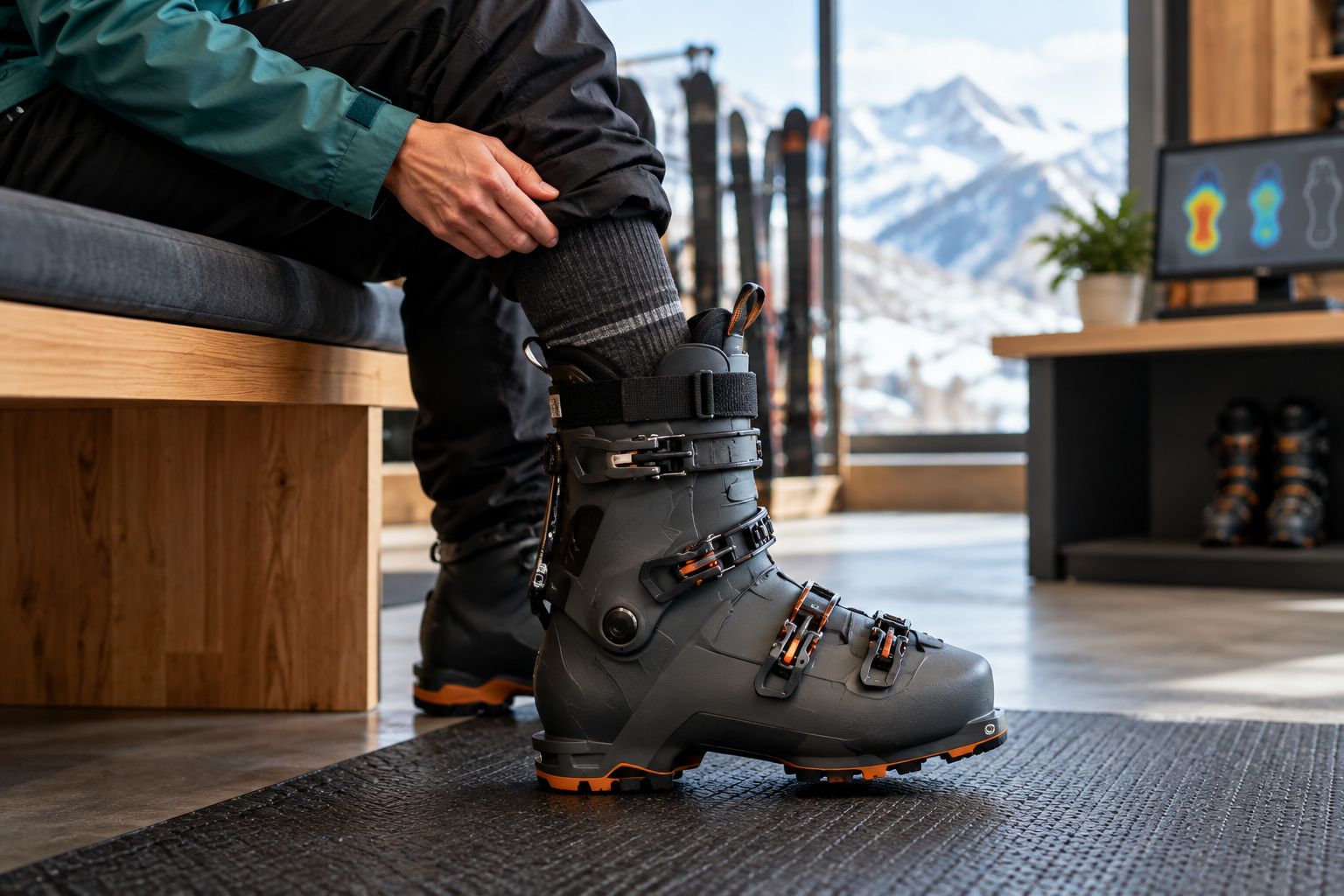
One test should not obscure another. If you change socks, footbeds, and buckle tension together, you lose a clear explanation for what improved or worsened.
- Bring the socks you actually tour in.
- Demonstrate your normal uphill closure settings.
- Describe heel movement rather than simply saying loose.
- Check cuff contact through a walking motion.
- Recheck support in the manufacturer's ski configuration.
4. Verify the complete boot-binding interface
Identify your exact boot and binding models before your appointment. Photograph identifying labels if you cannot bring the skis, but expect a technician to need the actual equipment for inspection or testing.
Boot sole standards describe interfaces, not universal compatibility. ISO 5355 covers alpine ski boot soles; ISO 9523 covers touring boot soles; ISO 23223 covers alpine boots with improved walking soles. The presence of a standard marking does not establish that every binding accepts that boot.
Tech inserts are another separate check. Do not assume that a walk mode, a lugged sole, or the word touring proves compatibility. Ask about the binding mount and test service and confirm whether the shop can assess your specific touring system.
- Identify the exact boot model and sole type.
- Identify the exact binding model and version.
- Check manufacturer compatibility documentation.
- Have sole wear and inserts inspected where applicable.
- Leave release adjustments and testing to a qualified technician.
5. Make targeted changes, then reassess
Begin with observations rather than home alterations. Note whether pressure feels localized against a bone, spread across the forefoot, or concentrated beneath a closure. Persistent numbness is a reason to stop and reassess, not a break-in target.
A fitter can evaluate whether foot support, liner work, closure adjustment, or a shell modification addresses the problem. Each has limits. Adding padding to an already crowded area can increase pressure, while removing material or changing shell shape requires model-specific judgment.
Skiboulder ski boot fitting gives local skiers an in-person assessment option; do not assume that every shell material, liner, or walk mechanism accepts the same work. Keep alterations away from critical interfaces unless the manufacturer permits the procedure and the technician is qualified to perform it.
- Describe the exact location and timing of symptoms.
- Review footbed placement and condition.
- Check for folded socks or liner material.
- Ask what each proposed change addresses.
- Reassess both touring and skiing configurations afterward.
6. Separate rentals, leases, and ownership decisions
Write down whether you need equipment for a particular outing, repeated seasonal use, or a long-term setup. That distinction helps you choose how to evaluate gear without confusing access to equipment with proof that it fits your backcountry objective.
Daily rentals and seasonal leases are different arrangements. Neither label establishes that boots have tech inserts, skis have touring bindings, or climbing skins are included. Skiboulder offers rentals and seasonal ski leases, but confirm touring suitability and equipment inclusions directly rather than treating a resort package as backcountry equipment.
Retail ownership provides continuity in the equipment you use and maintain. It also leaves you responsible for monitoring fit, liner wear, sole condition, and compatibility when components change. A familiar boot still needs reassessment when symptoms appear.
- State whether your intended use is resort or backcountry.
- Confirm the exact equipment included in any arrangement.
- Ask specifically about touring-compatible boots and bindings.
- Clarify how fitting concerns are handled.
- Recheck compatibility before combining equipment from different sources.
7. Test locally and maintain the whole setup
Make the first post-fitting check a controlled outing with an easy exit, not a remote objective. Follow the manufacturer's use instructions and stop if you develop numbness, sharp pain, or a mechanical problem.
Keep a brief fit log for your 2026 season. Record the socks, closure settings, snow conditions, and where symptoms begin. This gives your fitter a clearer problem to assess than a general report that the boots hurt.
Maintenance matters beyond the liner. Inspect soles, closures, and walk mechanisms; follow manufacturer drying and care instructions. Keep ski tuning and damage assessment separate from boot fitting: a dull edge or damaged base is not corrected by tightening a boot.
- Test changes somewhere you can stop easily.
- Record pressure and movement separately.
- Remove liners for drying only as instructed.
- Inspect soles and walk mechanisms for damage.
- Have ski edges and bases assessed when needed.
- Return with specific observations rather than adding random padding.
Compare your fitting options for 2026
Choose the assessment that matches the problem, not the most involved intervention. Home checks help you describe symptoms; professional fitting evaluates causes. Replacement makes sense when the existing shell or intended use is fundamentally wrong, not simply because a newer boot exists.
| Option | Best for | Main advantage | Key limitation |
|---|---|---|---|
| Home fit log and equipment inspection | Skiers preparing for a fitting | Organizes symptoms and equipment details | Does not establish shell suitability or binding compatibility |
| In-person boot assessment | Skiers with pressure, heel movement, or uncertain sizing | Allows direct assessment of feet and boots | Touring-specific work depends on the shop and equipment |
| Targeted liner or footbed work | Skiers whose shell fits but support or liner contact needs attention | Addresses a defined part of the fit | Cannot reliably correct an unsuitable shell |
| Replacement boot fitting | Skiers whose current boot shape or function is unsuitable | Lets you reassess the complete boot choice | Requires a fresh compatibility check and on-snow evaluation |
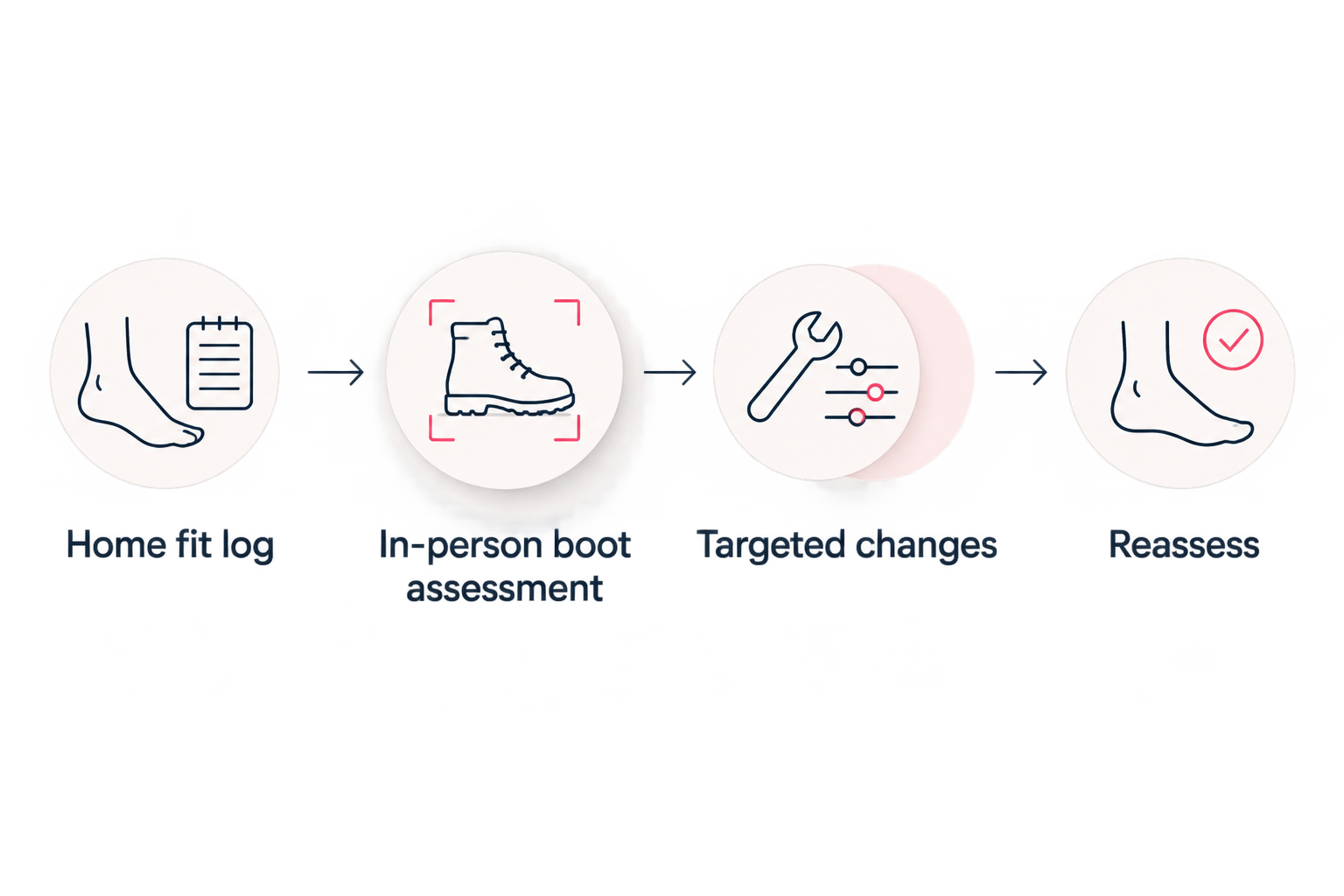
A useful fitting discussion ends with a clear explanation of what changed and what you should monitor. Ask which symptoms should prompt a return visit, and which equipment checks remain necessary before touring.
Common mistakes backcountry skiers make
- Sizing up to eliminate every pressure point. Extra volume can increase foot movement without resolving the original pressure source. Establish shell suitability before changing size.
- Testing only in walk mode. Uphill comfort does not prove downhill retention. Check both configurations using the manufacturer's instructions.
- Assuming a rental or lease includes touring equipment. Confirm the actual boot, binding, and accessory requirements. Package names do not establish backcountry suitability.
- Changing boots without checking bindings. Similar-looking soles are not a compatibility guarantee. Have the complete interface assessed before use.
- Blaming every control problem on boot stiffness. Fit, binding function, ski condition, and technique require separate assessment. Do not prescribe a stiffer boot from one symptom.
FAQ
What's different about ski boot fitting for backcountry skiers?
Backcountry boot fitting must assess repeated uphill movement as well as downhill support. The fitting also needs to account for walk-mode function and the exact boot-binding interface.
Should my toes touch the front of my touring boots?
Toe contact needs assessment in context, not a universal yes-or-no rule. A fitter should check shell length, toe position in a skiing stance, and whether touring movement creates repeated impact or pressure.
Can I use my alpine ski boots for backcountry skiing?
Do not assume alpine ski boots work with a touring setup. Confirm the exact boot and binding combination against manufacturer documentation; a compatible interface alone also does not establish suitable walking function.
Is heat molding enough to fix a painful touring boot?
Heat molding is not enough when the underlying shell shape or size is unsuitable. A fitter should identify whether the pressure comes from the liner, shell, foot support, or closure setup before selecting a correction.
What should I bring to a backcountry boot fitting?
Bring your boots, touring socks, existing footbeds, and exact binding information. Ask whether the technician needs your skis and bindings for an equipment assessment, and bring notes describing when symptoms appear.
Does Skiboulder fit backcountry ski boots?
Skiboulder offers ski boot fitting in Boulder; confirm touring-specific work for your exact boot before visiting. Ask about shell materials, walk mechanisms, and any binding assessment your setup requires.
Can I assume a seasonal ski lease works for touring?
No, a seasonal lease does not establish touring compatibility. Confirm the actual equipment and inclusions, including whether the boots and bindings support your intended use.
One last thing
Photograph your closure settings before your next 2026 test outing. Then record where and when discomfort appears. A clear record of the configuration helps you avoid comparing two outings that used different sock thicknesses, liner arrangements, or buckle tension.
Related guides
NEED A TUNE OR A FRESH SETUP?
– BETTER SKIING

- Professional Wintersteiger base grinds
- Precision edge sharpening
- Phantom Glide treatments
- Full binding safety checks
BOOK YOUR TUNE

KEEP YOUR GEAR
MOUNTAIN-READY
Keep your gear running
smooth — bring it to the experts.
0 comments