

REI alternatives for custom ski boot fitting

REI offers ski boots alongside a broad range of outdoor equipment, but a product selection alone cannot tell you whether a shell fits your foot. For Boulder skiers comparing REI alternatives for ski boots in 2026, Skiboulder is the best local fit-focused option if you need boot fitting, retail gear, and ski services in one shop; daily rentals are the better route for an occasional trip without choosing personal boots yet. This guide separates those choices from a season lease and explains what to check before committing to a setup.
TL;DR
- For Boulder skiers comparing REI alternatives for ski boots, Skiboulder combines boot fitting, retail gear, rentals, and tuning.
- Choose daily ski rentals for an occasional trip, not as a substitute for a personal boot-fitting assessment.
- Choose a season lease for season-long equipment use; confirm boot inclusion and fitting arrangements before selecting a package.
- Judge ski boots by shell fit, heel hold, and stance—not closure style or flex number alone.
Why this matters
A ski boot connects your movements to the binding and ski. Excess movement inside the boot delays that connection; concentrated pressure distracts you and can make skiing painful.
A tighter buckle is not a diagnosis. Neither is moving up a shell size whenever your toes touch the front while standing upright.
Skiboulder offers boot fitting alongside skis, boots, bindings, tuning, and rentals in Boulder. That combination makes it a relevant alternative when your question is about the whole setup rather than which boot to order.
REI alternatives at a glance for 2026
Compare the service route before comparing individual boots. Retail fitting, daily rentals, and season leases solve different equipment needs; none automatically makes a particular shell suitable for your feet.
| Option | Best for | Standout feature | Difference from shopping at REI | Main limitation |
|---|---|---|---|---|
| REI | Broad outdoor-equipment shopping | Ski boots within a wider outdoor retail selection | Baseline retailer in this comparison | Retail selection alone does not establish personal fit |
| Skiboulder boot fitting and retail | Boulder skiers choosing or assessing personal boots | Boot fitting, gear, rentals, and tuning at a local ski shop | A ski-focused service option for evaluating your setup | Requires a Boulder shop visit; no boot model fits everyone |
| Daily ski rentals | An occasional ski day or trip | Temporary equipment use; the Adult Ski Package includes skis, boots, and poles | Lets you ski without first selecting personal boots | A rental fitting is not the same objective as selecting a long-term personal shell |
| Season ski lease | Skiers seeking equipment for a season | A season-long rental route | Changes the equipment-use arrangement rather than the fundamentals of fit | Package contents and fitting arrangements need confirmation |
1. Skiboulder: best for personal ski boot fitting in Boulder
Best for: Local skiers who want help assessing boot fit and its connection to their skiing.
Skiboulder combines boot fitting with retail skis, boots, bindings, tuning, and rentals. Start with the fit problem—not a preferred model—and explain where you feel pressure, movement, or difficulty controlling the ski.
For a 2026 boot appointment, bring your existing boots if you have them. An assessment of what you already ski in gives the conversation a concrete starting point without assuming replacement is necessary.
Where this option shines
- You can discuss boots and the rest of your ski setup at the same shop.
- The service offering includes both boot fitting and equipment maintenance.
- Rentals provide a separate route when you are not ready to select personal equipment.
- A Boulder location gives local skiers a practical place to bring equipment for assessment.
Where this option falls short
- An in-person Boulder fitting does not suit someone seeking a remote-only purchase.
- A shop's fitting service does not make every boot in its catalog appropriate for you.
- Boot fitting does not replace binding compatibility checks or ski maintenance.
| Decision point | Local fitting route | REI shopping route |
|---|---|---|
| Starting question | What fit problem or skiing need should the boot address? | Which ski boots should you consider? |
| Service context | Boot fitting, retail, rentals, and tuning are stated offerings | Confirm the relevant store's fitting services directly |
| Equipment to bring | Existing boots, ski socks, and current footbeds help explain your setup | Confirm appointment and equipment requirements directly |
| Final selection | Choose after assessing fit | Assess fit rather than selecting from product details alone |
Verdict: Buy only after the fit assessment supports the boot; hold if pressure or heel movement remains unexplained.
2. Daily ski rentals: best for an occasional trip
Best for: Skiers who need a temporary setup rather than personal boots.
The Adult Ski Package includes skis, boots, and poles fitted in the shop before you head to the mountain. That makes daily rental a distinct alternative to shopping for boots, not a competing form of custom fitting.
Tell the rental technician about pressure or heel lift before leaving. Do not accept painful fit on the assumption that a rental boot must feel that way.
Where daily rentals shine
- You can arrange the ski setup without first choosing personal boots.
- The stated adult package brings skis, boots, and poles together.
- An in-shop fitting gives you an opportunity to identify immediate fit problems.
Where daily rentals fall short
- Temporary equipment use does not establish which shell you should own.
- Rental fit should not be described as a custom modification service.
- A particular rental boot's feel does not establish how every boot from that manufacturer fits.
| Decision point | Daily rental | REI retail boot selection |
|---|---|---|
| Main purpose | Equipment for a ski day or trip | Selecting equipment to own |
| Boot decision | Find an appropriate rental fit | Assess suitability for ongoing personal use |
| Equipment scope | Adult package states skis, boots, and poles | Depends on the equipment you select |
Verdict: Hold on buying personal boots when your immediate need is a temporary ski setup.
3. Season ski leases: best for season-long equipment use
Best for: Skiers whose equipment plans cover a season rather than an isolated trip.
A season lease changes how long you use the equipment. It does not remove the need to assess boot fit or confirm what the selected package includes.
Adult Season Ski Lease and Demo Season Ski Lease are listed options. Choose by the equipment purpose and your skiing plans, then confirm boot inclusion, fitting arrangements, and any equipment-change terms directly with the shop.
Where season leases shine
- They provide a season-long alternative to selecting an owned setup.
- Separate adult and demo lease listings give you different equipment routes to discuss.
- They keep the decision focused on how you intend to use the equipment through winter.
Where season leases fall short
- A lease name alone does not establish that boots are included.
- Season-long use does not make an unsuitable boot fit correctly.
- Do not assume that adjustments, exchanges, or maintenance are included without confirmation.
| Decision point | Season lease | REI retail boot selection |
|---|---|---|
| Main purpose | Season-long equipment use | Personal equipment ownership |
| Essential confirmation | Package contents and fitting arrangements | Individual boot suitability |
| Fit standard | Secure, appropriate fit still matters | Secure, appropriate fit still matters |
Verdict: Hold until the lease contents and boot-fitting arrangements match your needs.
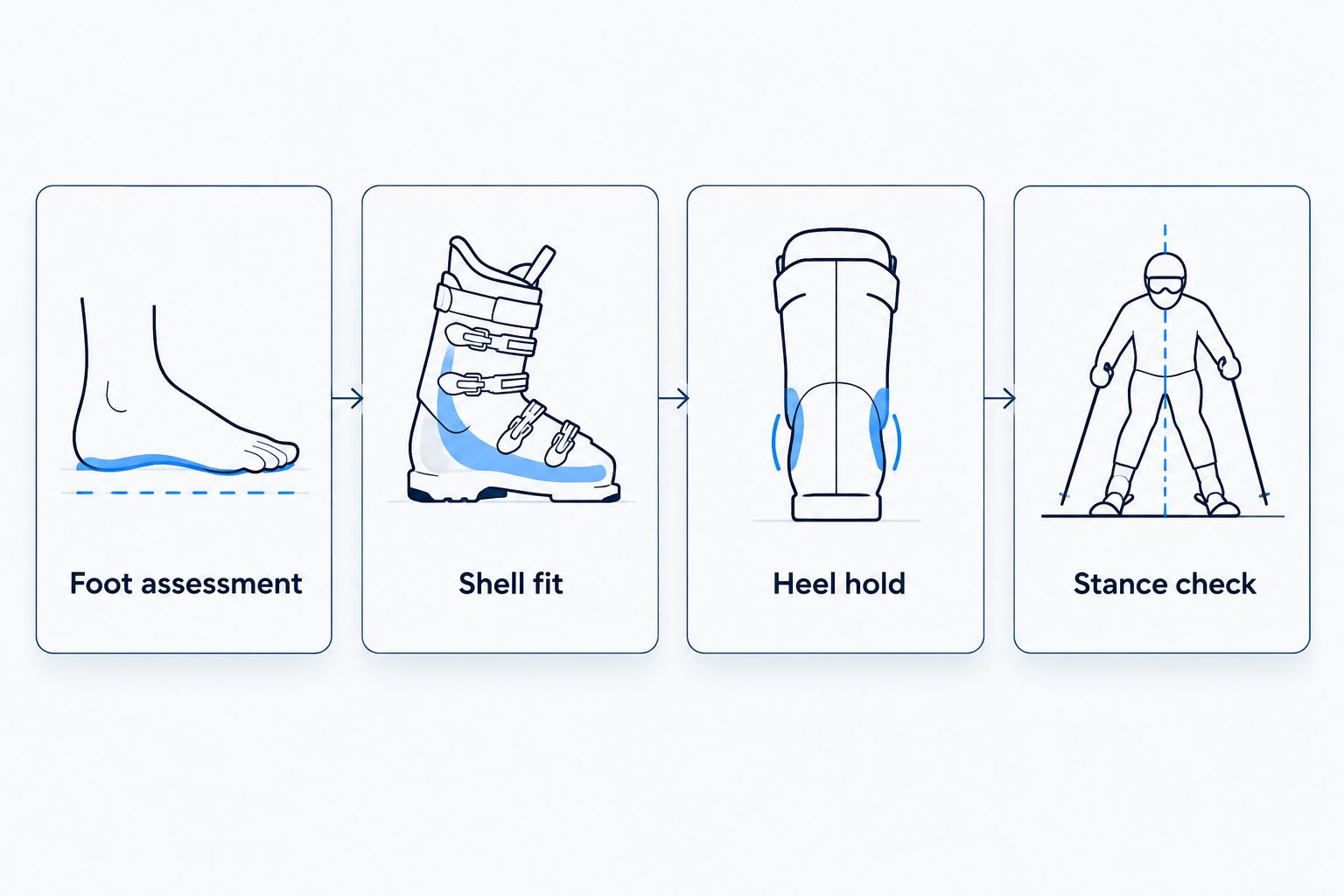
What a useful boot-fitting conversation should cover
Custom ski boot fitting starts with assessment, not automatically with modification. A shell that matches your foot is a different starting point from a shell that needs extensive correction.
Use these checkpoints when comparing fitting options in 2026. They are questions to resolve with a fitter, not instructions for modifying boots yourself.
Foot assessment
Have both feet assessed. Your 2 feet need not have identical dimensions, so describe differences in pressure rather than treating one comfortable foot as proof that the pair fits.
Bring 1 pair of thin ski socks that you intend to use while skiing. Changing sock thickness during the assessment changes the fit being evaluated.
Shell fit
Ask how the shell's length and shape relate to your foot. A liner can feel soft in the shop while concealing a mismatch between your foot and the shell around it.
A shell assessment with the liner removed helps separate shell space from liner cushioning. Leave clearance judgments to the fitter rather than applying a universal finger-width rule.
Heel hold
Flex forward in a skiing stance and describe what moves. Useful feedback identifies whether the heel lifts, the whole foot slides, or pressure concentrates around the instep.
Do not keep tightening closures to conceal movement. The fitter needs to distinguish closure adjustment from a shape or volume mismatch.
Stance check
Discuss how the boot supports your skiing position and whether you can flex it appropriately. A printed flex number is not a complete description of how a boot will work for you.
Bring 3 observations from skiing: where discomfort occurs, what movement you feel, and when control becomes difficult. Those observations are more useful than saying a boot simply feels wrong.
Why people switch from REI
The clearest reason to choose an alternative in 2026 is a different service need—not an assumption that REI boots are unsuitable. A particular skier can outgrow a product-only shopping approach without outgrowing a particular retailer.
Choose a fitting-led route when you need help interpreting heel movement, localized pressure, or the relationship between your foot and the shell. Choose rental or lease equipment when ownership is not the decision you need to make yet.
These are reasons to change the shopping approach. They are not evidence of deficiencies in REI's staff, fitting services, or policies.
Keep boot fit separate from ski condition
A boot problem and a tune problem can both affect confidence, but they require different checks. Describe whether your foot moves inside the boot, the ski struggles to hold an edge, or the ski feels reluctant to glide.
Dull edges, base damage, and wax condition belong in a ski-maintenance assessment. Changing boots does not sharpen an edge or repair a base.
Likewise, a tune does not correct a poorly matched boot shell. Ask for a diagnosis of the symptom before choosing the service.
When staying with REI is the right call
Stay with REI if you find a suitable boot and can obtain the fitting assessment and follow-up support you need. The retailer's name is not a reason to reject a shell that genuinely works for your feet.
Before making your 2026 selection, ask the relevant location what fitting services it provides and how it handles fit questions after skiing. Apply the same questions to any specialty shop.
Do not switch merely to obtain a different logo, closure system, or higher flex number. Switch when another service route better addresses your actual equipment need.
FAQ
What's the best REI alternative for ski boot fitting in Boulder?
Skiboulder is the best local fit-focused option in this comparison because it explicitly offers boot fitting alongside retail gear, rentals, and tuning. Choose the boot after an assessment rather than assuming a particular model will suit your feet.
Is a specialty ski shop always better than REI for boots?
No. The right choice is the retailer that can assess your fit and provide the services you need. Confirm the specific location's fitting capabilities rather than judging by the retailer's category alone.
Should I rent ski boots before choosing personal boots?
Rent when you need temporary equipment and are not ready to select personal boots. Rental experience can help you describe pressure and movement, but it does not replace a personal boot-fitting assessment.
Does a season ski lease include boots?
Confirm boot inclusion for the exact season lease you select. A season lease title alone does not establish its equipment contents, fitting arrangements, or adjustment terms.
Does custom ski boot fitting always mean heat molding?
No. Boot fitting begins with assessing your feet and the boot's suitability. Heat molding or other modifications depend on the specific boot, its materials, and the fitter's assessment.
Should I choose ski boots by flex number?
No. Flex is one consideration alongside shell shape, foot volume, stance, and skiing needs. Flex ratings are not standardized across all manufacturers, so a number alone is not a reliable cross-brand fit comparison.
Do new ski boots need a binding check?
Yes. Have a qualified technician check boot-binding compatibility and the binding setup before skiing with different boots. Matching a sole-length marking alone does not establish correct adjustment or release function.
One last thing
Photograph the markings on your current boot soles and bring the boots themselves when discussing a change. The boot sole length is not the same measurement as the boot's nominal size, and a replacement boot can require binding adjustment even when its labeled size looks familiar.
Choose the fit first, then have the boot-binding system checked. A comfortable shop fitting and a correctly checked ski setup answer different questions; you need both.
Related guides
NEED A TUNE OR A FRESH SETUP?
– BETTER SKIING

- Professional Wintersteiger base grinds
- Precision edge sharpening
- Phantom Glide treatments
- Full binding safety checks
BOOK YOUR TUNE

KEEP YOUR GEAR
MOUNTAIN-READY
Keep your gear running
smooth — bring it to the experts.
0 comments