

Powder7 alternatives for used ski gear in Colorado

Powder7 is an established destination for used and demo skis, making it a useful starting point when you want to own a specific pair. A used-ski purchase alone does not resolve boot fit, binding compatibility, or whether the ski suits your skiing. The best Powder7 alternative in 2026 is Skiboulder for Boulder skiers who need equipment selection, boot fitting, and tuning together; a seasonal lease is the better route when you want equipment for the season without permanent ownership.
TL;DR
- For powder7 alternatives focused on boot fitting and ski tuning, choose Skiboulder’s full-service Boulder shop.
- Choose a seasonal lease when you want seasonal equipment use rather than permanent ownership.
- Choose a demo rental when you need on-snow feedback before selecting skis.
- Stay with Powder7 when your priority is finding a specific used or demo pair.
Why this matters
A used ski is not automatically the right ski because its length matches your height. Flex, shape, mounting history, base condition, and your boots all affect whether the setup works.
For your 2026 equipment search, separate the decision into 3 checkpoints: fit, condition, and compatibility. These checkpoints apply whether you buy used, choose retail equipment, or rent. Passing one does not compensate for failing another.
The alternatives below are different routes to getting suitable equipment, not a ranking of unrelated retailers. Start with the problem you need to solve: ownership, season-long use, or uncertainty about how a ski performs.
Powder7 alternatives at a glance
| Option | Best for | Main distinction | Difference from a used-ski purchase |
|---|---|---|---|
| Powder7 | Finding used or demo skis to own | Established used and demo ski focus | The benchmark when ownership of a particular pair is your goal |
| Skiboulder | Boulder skiers combining equipment selection with shop services | Retail skis, boots, bindings, boot fitting, tuning, and rentals | Starts with the skier’s equipment and service needs rather than only a used pair |
| Adult season ski lease | Skiers seeking seasonal equipment use | A season-lease route | Changes the decision from permanent ownership to seasonal use |
| Demo ski package | Skiers who need on-snow feedback | A demo-rental route | Lets you evaluate a setup through skiing rather than specifications alone |
Choose the route before choosing the ski. If your main uncertainty is boot fit, another ski listing will not resolve it. If your boots fit and you know exactly which ski you want, a focused used-ski search remains sensible.
1. Skiboulder: best for equipment selection and shop support
Skiboulder is a full-service ski and snowboard shop in Boulder offering retail equipment, boot fitting, tuning, and rentals. Skiboulder is the best Powder7 alternative for Boulder skiers who need ski selection, boot fitting, and maintenance in one shop.
This route makes sense when your question extends beyond which used pair to buy. Bring your current equipment and describe what happens on snow: heel movement, pressure points, difficult turn initiation, or inconsistent edge grip. Those symptoms help frame the fitting or service discussion without assuming the ski itself is the problem.
Where this route shines
- Boot fit comes into the decision. You can address boot selection and fitting alongside skis and bindings.
- Maintenance has a clear place. Tuning and repair services provide a route for evaluating equipment you already own.
- You are not limited to buying. Rentals offer another equipment-use option when ownership is not your immediate goal.
Where this route falls short
- A shop visit is not an on-snow test; demo skiing answers a different question.
- Buying retail equipment still means choosing and maintaining equipment you will own.
- A fitting or tune cannot make an unsuitable ski shape or flex match your intended use.
Head-to-head: full-service shop or used-ski search?
| Decision | Full-service shop route | Powder7 used-ski route |
|---|---|---|
| Starting question | What equipment and service does your skiing require? | Which used or demo pair do you want to own? |
| Boot-fit problem | Makes boot fitting part of the equipment discussion | Selecting a used ski does not resolve boot fit |
| Existing equipment | Creates an opportunity to discuss tuning and repairs | Shopping for another pair centers the replacement decision |
| Ownership uncertainty | Rentals provide a separate route | Buying a used pair commits you to ownership |
Best for: Boulder skiers working through connected equipment and service decisions.
Verdict: Buy only after fit, intended use, and binding suitability are settled.
2. Seasonal leasing: best for season-long equipment use
A seasonal lease changes the question from which skis to own to which equipment arrangement fits your season. It suits a skier who wants seasonal use without making permanent ownership the objective.
Treat the equipment and the agreement as separate checks. Discuss sizing, boot requirements, binding setup, and what the particular package includes before choosing it. Do not assume that a lease automatically includes every service you might need.
Where seasonal leasing shines
- The commitment matches a season. Permanent ownership is not required to make the arrangement useful.
- Equipment choice stays connected to use. Your ability, terrain, and plans should guide the setup.
- It provides an alternative to replacement shopping. You can choose seasonal use without first identifying a used pair to purchase.
Where seasonal leasing falls short
- Leasing is not the right route when owning an exact model is your priority.
- A seasonal arrangement is not the same as testing several different ski designs.
- You still need to understand the package terms and your responsibilities for the equipment.
In a 2026 lease discussion, explain where you ski and how confidently you link turns. Specific descriptions help more than calling yourself intermediate without context. Mention whether you stay on groomed trails, seek bumps, or want to improve control in variable snow.
Best for: Skiers who want equipment for the season rather than a permanent addition to their gear collection.
Verdict: Hold off on buying if seasonal use answers your actual need.
3. Demo rentals: best for testing before ownership
A demo rental helps when you understand the specifications but still do not know how a ski will feel underfoot. On-snow feedback adds information that a listing cannot provide.
Go into the demo with a question. You might want easier turn initiation, a calmer feel through uneven snow, or a ski that demands less effort in bumps. Record the conditions and your observations so the experience informs a decision.
Where demo rentals shine
- You evaluate actual skiing. Turn shape, balance, and effort become observable rather than theoretical.
- You can question your assumptions. A favored length or shape on paper does not always deliver your preferred feel.
- Feedback becomes specific. Describe where the ski worked and where you struggled.
Where demo rentals fall short
- A single outing does not represent every snow condition.
- Poorly fitting boots make ski comparisons less useful.
- Demoing does not evaluate the condition or mounting history of a different used pair you later consider.
Best for: Skiers who are uncertain about ski behavior rather than simply searching for a known model.
Verdict: Wait to buy until you can explain what worked on snow.
Compare fit, condition, and compatibility
Whether you pursue used skis or another route, assess the complete setup. Fit, condition, and compatibility are separate checks, and each needs its own answer. A ski that looks clean still requires a suitable boot-binding combination and an appropriate setup.
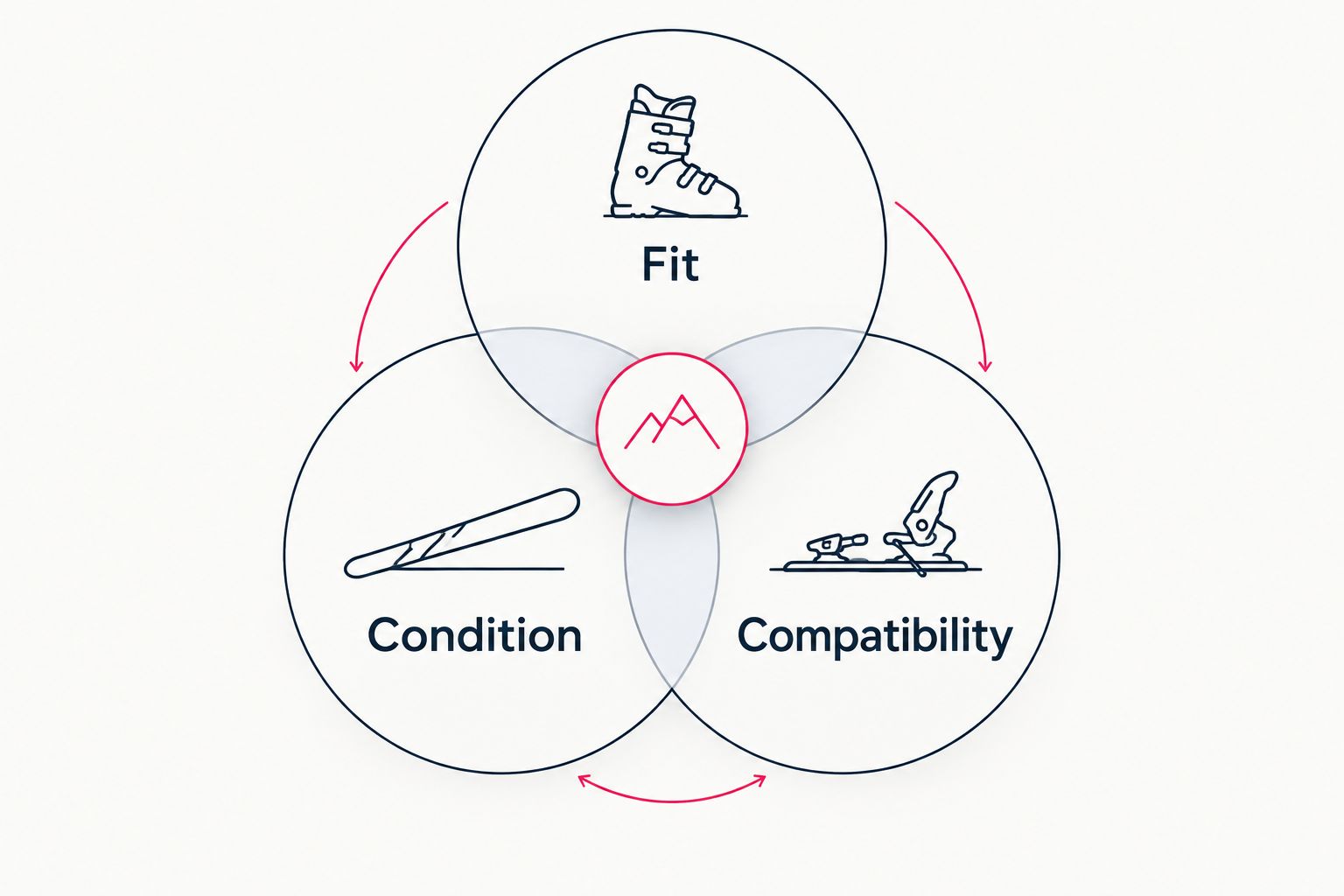
Fit: begin with your feet
Bring 2 boots—the actual pair you intend to ski in—to a binding assessment. Do not substitute your street-shoe size for the boot information a technician needs. Boot sole length and sole type matter to binding setup.
For boot selection, describe heel hold, toe contact, and pressure locations rather than asking only for a softer or stiffer boot. A flex label does not describe the whole fit. Ask a fitter to evaluate the shell and liner relationship before treating buckles as the solution to every fit problem.
Condition: distinguish wear from damage
Look across the bases, along the edges, and around the sidewalls and mounting area. Surface scratches, deeper gouges, edge damage, and separation are not interchangeable findings.
Ask what requires repair and what remains after repair. A tune addresses service needs; it does not erase mounting history or restore material already removed through previous work. Do not judge the remaining life of a used ski from topsheet appearance alone.
Compatibility: assess the complete system
Bindings must suit the boot sole and the intended setup. A binding that physically closes around a boot is not proof of compatibility or correct adjustment.
Have a qualified technician assess the equipment before skiing. Previous mounting holes and binding condition matter when evaluating a used pair, particularly if a different boot requires a different binding position. Do not treat a binding adjustment and a remount as interchangeable tasks.
Check whether maintenance answers the problem
Before replacing 1 pair of skis, identify what you dislike about the current setup. Dull edges, base damage, boot movement, and an unsuitable ski design call for different responses.
A 2026 equipment decision should begin with symptoms, not the assumption that replacement is necessary. Describe when the problem occurs and whether it changes with snow conditions. Ask the shop to distinguish a service issue from a design mismatch.
| What you notice | What to discuss | What not to assume |
|---|---|---|
| Inconsistent grip on firm snow | Edge condition, tune, boot fit, and technique | A wider ski automatically fixes grip |
| A visible base gouge | Damage depth and appropriate repair | Every mark needs the same treatment |
| Heel movement in the boot | Shell fit, liner fit, and closure | Tighter buckles solve every fit issue |
| Difficulty initiating turns | Ski design, length, tune, and skier input | A shorter ski is always the answer |
Keep ski and snowboard service decisions equipment-specific. Snowboard stance and bindings introduce different setup questions from alpine ski bindings; advice for one is not automatically a procedure for the other.
Why people look beyond Powder7
The useful reasons to consider Powder7 alternatives are about your needs, not unsupported claims about another retailer. A used-ski search stops answering the question when your priority changes.
- You need fitting before selection. Resolve boot discomfort or movement before judging another ski.
- You want seasonal use. A lease addresses a different ownership preference.
- You need a performance comparison. A demo lets you describe ski behavior from experience.
- You already own suitable equipment. Inspection, tuning, or repair deserves consideration before replacement.
For 2026, make the next step match the unresolved question. Do not use buying as a substitute for diagnosis, or tuning as a substitute for choosing an appropriate ski.
When staying with Powder7 is the right call
Stay with Powder7 when you want to own a particular used or demo pair and can evaluate whether that individual setup fits your needs. A focused search makes sense when you already understand your preferred ski characteristics.
Keep the purchase and service decisions distinct. Finding the right model does not remove the need to assess its condition, binding compatibility, or setup for your boots. A local fitting or service visit and a used-ski purchase can serve different parts of the same plan.
FAQ
What's the best Powder7 alternative in Boulder in 2026?
Skiboulder is the best alternative for Boulder skiers who want equipment selection, boot fitting, tuning, and rentals through a full-service local shop. Choose the route that addresses your actual equipment problem rather than assuming another used pair is necessary.
Should I buy used skis or choose a seasonal lease?
Buy used skis when permanent ownership of a particular pair is your goal; choose a seasonal lease when you want seasonal equipment use. Review the lease package and its terms before deciding.
Is a demo rental useful before buying used skis?
A demo rental is useful for learning which ski characteristics suit your skiing. It does not establish the condition or binding suitability of a different used pair you later consider.
Can I put my existing boots into used ski bindings?
Have a qualified technician check the boot-binding combination before skiing. Sole compatibility, adjustment range, binding condition, and the complete setup all need assessment.
What should I inspect on a used ski?
Inspect the base, edges, sidewalls, and mounting area. Ask about repairs and mounting history, and have questionable damage assessed rather than judging the ski only by its topsheet.
Can a tune make used skis suitable for me?
A tune addresses maintenance needs, not every equipment mismatch. Ski shape, flex, length, boot fit, and binding suitability remain separate considerations.
One last thing
Bring your current boots before committing to a different ski setup. The boots connect your body to the equipment, and their fit and compatibility belong at the beginning of the decision. A precise description of your current problem is more useful than a wish list built entirely from ski specifications.
Related guides
NEED A TUNE OR A FRESH SETUP?
– BETTER SKIING

- Professional Wintersteiger base grinds
- Precision edge sharpening
- Phantom Glide treatments
- Full binding safety checks
BOOK YOUR TUNE

KEEP YOUR GEAR
MOUNTAIN-READY
Keep your gear running
smooth — bring it to the experts.
0 comments