

Best ski binding mounting options ranked by ski type

Best overall: a manufacturer-recommended alpine mount for flat resort skis. Best for frontside system skis: the matching integrated binding; best for freestyle: a ski-specific park mount. This 2026 guide ranks ski binding mounting options by ski type, boot compatibility and intended use, with Binding Mount and Test as the starting service for a new drilled setup.
TL;DR
- For ski binding mounting, choose the ski’s intended system and confirm compatibility with your actual boots.
- Skiboulder is best for Boulder skiers seeking ski binding mounting alongside boot fitting and tuning.
- Flat skis, integrated systems, touring skis and race plates require different mounting decisions.
- A boot change requires a compatibility check; moving the heel alone does not complete the job.
Why this matters
A binding connects your boot to your ski, but the right setup involves more than fastening hardware. Mount position affects how the ski responds, while boot compatibility, adjustment and testing determine whether the binding operates as intended.
Choose the mounting approach before choosing a binding by reputation. In 2026, a resort skier, a park skier and a touring skier still need different answers—even when their skis look similar on a rack.
What makes the best ski binding mounting option?
Use these criteria to judge every option below:
- Ski construction: A flat ski, integrated track and race plate require different installation methods.
- Boot compatibility: The binding must explicitly accept the boot’s sole standard and configuration.
- Intended terrain: Resort skiing, freestyle, racing and touring place different demands on the setup.
- Mount reference: Start with the ski manufacturer’s mark or instructions, not a universal position.
- Adjustment and testing: Installation must include the relevant manufacturer-prescribed setup and checks.
- Existing condition: Previous holes, damaged mounting areas and worn boot soles affect the decision.
Skiboulder offers ski binding mounting, boot fitting and tuning in Boulder. Bring those decisions together: settle boot fit before drilling, and address damaged skis before treating a new binding as the answer.
Ski binding mounting options at a glance
The order below starts with the broadest resort application. It is a decision tree, not a claim that an alpine mount is better than a touring setup for every skier.
| Option | Best for | Standout feature | Key limitation |
|---|---|---|---|
| Recommended alpine mount | Flat all-mountain resort skis | Uses the ski’s intended mounting reference | Does not provide touring capability |
| Integrated system setup | Frontside skis with matching tracks | Uses the designated ski-binding interface | Binding choice is restricted by the system |
| Ski-specific park mount | Freestyle and switch skiing | Position reflects the ski’s freestyle design | A centered position is not right for every twin-tip |
| Touring-specific mount | Skis intended for uphill travel | Supports the selected touring interface | Boot and binding requirements need close checking |
| Race-plate installation | Race skis with designated plates | Preserves the specified plate-binding combination | Plate compatibility limits substitutions |
| Assessed remount | Previously drilled skis | Reuses suitable skis with a revised setup | Existing holes and damage constrain placement |
1. Recommended alpine mount: best for flat resort skis
A conventional alpine binding is the default choice for flat skis used on lifts and downhill terrain. The technician positions the boot using the ski manufacturer’s reference, installs the binding according to its instructions, then completes adjustment and testing.
Best for: Skiers using flat all-mountain or directional resort skis without an integrated binding track.
Recommended alpine mount pros
- Matches the intended use of a conventional resort setup.
- Uses the ski manufacturer’s reference as a clear starting point.
- Allows selection from compatible alpine bindings rather than a proprietary track system.
Recommended alpine mount cons
- Requires drilling when the ski has no existing compatible installation.
- Does not add an uphill walking mode.
Boot choice comes first. A different boot can have a different external sole length even when its labeled foot size looks similar; the binding’s adjustment range determines whether that change requires a remount.
For a new resort setup in 2026, start here unless the ski requires a dedicated system. Verdict: Buy this mounting approach for flat resort skis after confirming the boots and binding are compatible.
2. Integrated system setup: best for frontside system skis
An integrated system uses a track or interface designed for a specified family of bindings. The technician follows the system’s installation and adjustment instructions rather than treating the ski like an undrilled flat ski.
Best for: Frontside skis supplied with a designated integrated binding interface.
Integrated system setup pros
- Retains the ski’s intended binding interface.
- Allows adjustment within the system’s specified range.
- Avoids treating a proprietary track as a generic mounting surface.
Integrated system setup cons
- Restricts binding selection to approved compatible components.
- Still requires boot compatibility checks, adjustment and testing.
Do not assume every binding that slides onto a rail belongs on that rail. Similar-looking systems are not proof of compatibility, and a track does not eliminate the need to check forward pressure and other required settings.
A changed boot does not automatically mean drilling. If the existing system accepts the boot and provides enough adjustment, the appropriate work is adjustment and testing. Verdict: Buy the designated system setup for integrated frontside skis; skip improvised substitutions.
3. Ski-specific park mount: best for freestyle skiing
A park mount places the boot according to the ski’s freestyle design and your intended balance of forward and switch skiing. Some freestyle skis use a more centered reference than directional skis, but a twin-tip shape alone does not establish the correct position.
Best for: Skiers prioritizing park features, switch skiing and freestyle balance.
Ski-specific park mount pros
- Matches mounting position to freestyle use.
- Lets you discuss forward-versus-switch priorities before drilling.
- Uses the ski’s designated reference rather than appearance alone.
Ski-specific park mount cons
- Moving forward changes the ski’s directional balance.
- An unsuitable position creates a remount decision rather than a simple binding adjustment.
Do not ask for true center just because a ski has twin tips. Explain whether you mainly ski jumps, rails, switch or mixed resort terrain, then compare that use with the manufacturer’s recommended position.
For a 2026 park setup, resolve the position before installation rather than copying another skier’s measurements. Verdict: Buy a ski-specific park mount for deliberate freestyle use; skip a centered mount chosen only for appearance.
4. Touring-specific mount: best for uphill travel
A touring setup must work with the boot and binding interfaces used for climbing and descending. Tech bindings require suitable boot inserts; hybrid designs have their own compatibility requirements and operating procedures.
Best for: Skiers deliberately building a touring-capable setup, rather than simply selecting a wider resort ski.
Touring-specific mount pros
- Supports uphill travel with the appropriate equipment.
- Matches installation to the selected touring binding.
- Makes climbing and descending requirements part of the same decision.
Touring-specific mount cons
- Adds compatibility requirements beyond a conventional alpine setup.
- Requires model-specific operation and maintenance knowledge.
A walking cuff does not prove that a boot works with a tech binding. Likewise, a touring-capable binding does not make every alpine boot suitable for its climbing mode.
Ask the technician to verify the complete combination using the relevant manufacturer instructions. Binding installation also does not replace avalanche education, terrain judgment or rescue preparation. Verdict: Buy a touring-specific mount only when uphill travel is an actual requirement.
5. Race-plate installation: best for dedicated race skis
Race skis often use a plate that determines which bindings and mounting positions are permitted. Installation follows the ski, plate and binding instructions as a combined system—not a collection of interchangeable parts.
Best for: Racers using skis with a designated race plate and compatible binding.
Race-plate installation pros
- Preserves the specified ski-plate-binding combination.
- Uses the plate’s intended installation positions.
- Supports a setup selected for the skier’s race discipline.
Race-plate installation cons
- Limits substitutions to compatible components.
- Requires particular attention when changing boots or buying used race equipment.
For junior racers, evaluate the skier rather than choosing the most demanding-looking hardware. The binding must suit the skier’s required settings, boot and equipment instructions; a higher release-setting range is not a performance upgrade by itself.
Discuss race discipline, current boots and any equipment requirements before installation. Verdict: Buy the approved plate-binding setup for dedicated race skis; skip unverified combinations.
6. Assessed remount: best for previously drilled skis
A remount moves or replaces an existing drilled installation. The technician must assess previous holes, the proposed pattern and the ski’s condition before confirming that the new setup is suitable.
Best for: Used skis, binding replacements or boot changes that cannot be accommodated by an appropriate adjustment.
Assessed remount pros
- Allows suitable existing skis to receive a different setup.
- Addresses changes beyond the binding’s adjustment range.
- Creates an opportunity to inspect the mounting area and previous work.
Assessed remount cons
- Existing holes constrain the new installation.
- Damage or unsuitable hole placement can rule out the requested setup.
There is no universal remount allowance that makes every used ski acceptable. Hole condition, spacing, construction and manufacturer guidance matter more than a seller’s assurance that another mount will fit.
Do not move the boot away from the intended reference merely to force an installation. Verdict: Hold until the skis have been inspected; proceed only with an accepted mounting plan.
What to bring before a mounting appointment
Bring the actual equipment, not just model names. A photograph of a boot label helps identify it, but the technician needs the boot to assess the interface and complete the relevant setup.
- Boot fit: Bring both current boots and explain any fit problem before committing to a mount.
- Compatibility: Bring the skis, bindings and any supplied plates or hardware.
- Mount reference: State your terrain, skiing direction and any requested position change.
- Adjustment: Explain whether the boots or bindings have changed since the previous setup.
- Testing: Ask which checks apply to the particular binding system.
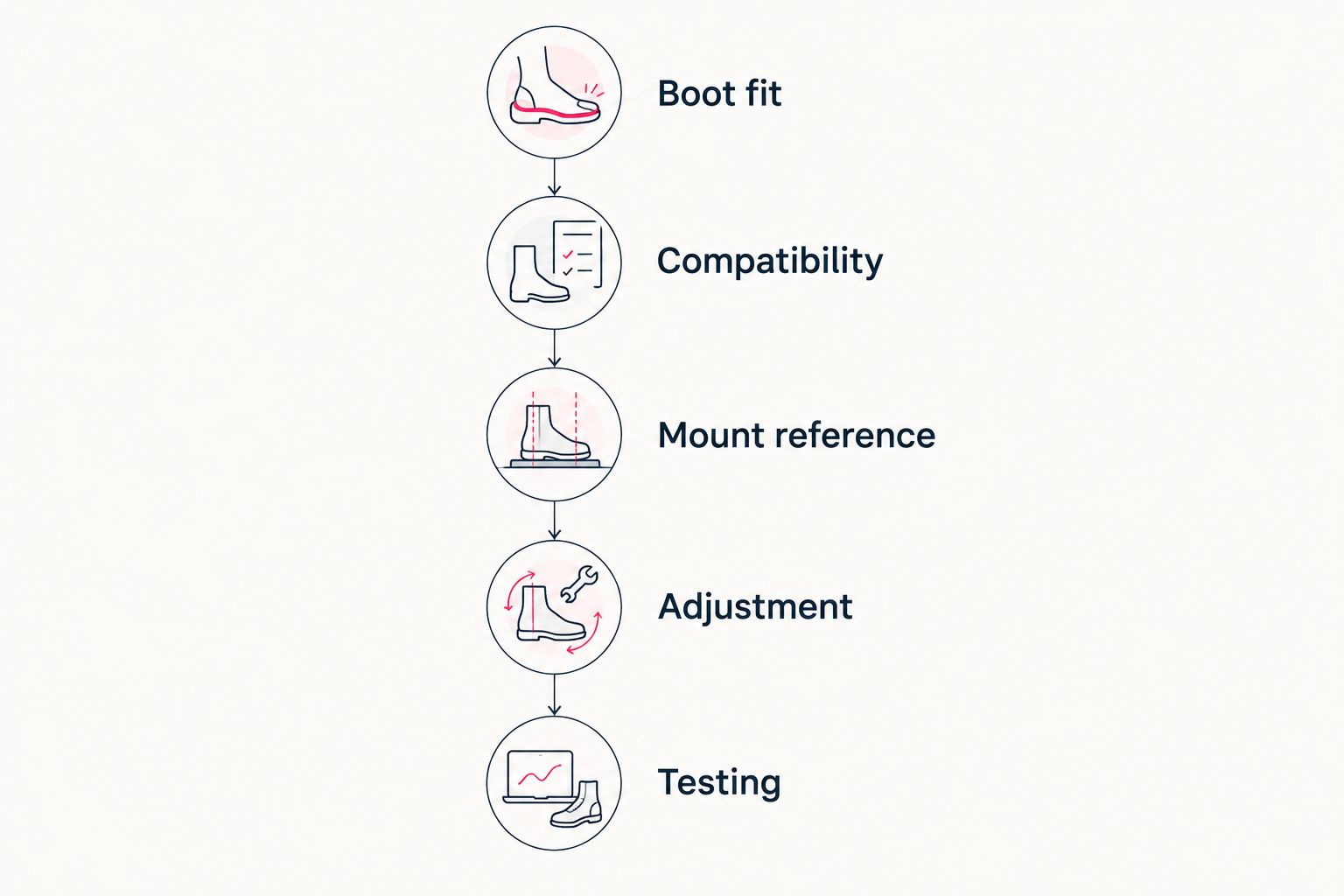
For a 2026 equipment change, distinguish a new installation from an adjustment. If the binding accepts the new boot within its approved range, Binding Adjust with Torque Test addresses a different need from drilling new holes.
Rentals, leases and maintenance change the decision
Rental and seasonal-lease equipment should return to the provider for setup changes. Do not reposition rental bindings yourself or assume a different boot is acceptable because it clicks into place.
Skiboulder provides rentals, retail equipment, boot fitting and tuning. For a rental or lease, describe your ability and intended terrain; for owned equipment, bring the actual setup and explain what has changed.
Keep mounting and maintenance separate. Sharp edges, appropriate wax and sound bases affect on-snow behavior, but none correct an incompatible boot-binding interface. Conversely, a correctly installed binding does not repair base damage or restore neglected edges.
If your boot fit is unresolved, settle that before drilling new skis. That sequence applies whether you are moving from rentals to owned equipment or replacing a long-used setup.
How the options are ranked
This ranking prioritizes ski construction, boot compatibility and intended terrain before preference for a particular binding. Adjustment, testing and existing condition then determine whether the proposed installation is appropriate.
The first option is the default for flat resort skis, not a universal winner. An integrated system belongs on its matching interface; a touring requirement moves the touring option ahead of the resort choices.
Which ski binding mounting option should you choose?
For most flat resort skis, choose a compatible alpine binding at the manufacturer’s recommended reference. Choose the matching integrated setup for system skis, a deliberate ski-specific position for park skis, and the approved interface for touring or race equipment.
For previously drilled skis, inspection comes before commitment. In 2026, the most useful mounting question remains straightforward: does this complete ski, binding and boot combination match the skier’s intended use?
FAQ
What’s the best ski binding mounting option for all-mountain skis?
A compatible alpine binding at the manufacturer’s recommended reference is the default for flat all-mountain resort skis. Skis with an integrated interface need their designated system instead.
Should I mount park skis at true center?
Do not choose true center automatically. Start with the ski manufacturer’s reference and discuss how much you ski switch, use park features and ski directional terrain.
Can I use new ski boots without remounting my bindings?
A remount is unnecessary if the binding accepts the new boot and provides sufficient approved adjustment. A technician must still check compatibility, adjust the setup and complete the relevant testing.
Do integrated ski bindings still need adjustment and testing?
Yes, integrated bindings still need the required adjustment and testing. A track changes the installation method, not the need to verify the boot-binding setup.
Can every used ski accept another binding mount?
No, a used ski needs inspection before another mount is approved. Existing holes, their condition, ski construction and the proposed binding pattern determine the options.
Will any ski boot work with a touring binding?
No, touring bindings require explicitly compatible boots. Tech bindings need suitable inserts, while hybrid systems have model-specific requirements for climbing and descending.
Should I finish boot fitting before mounting new skis?
Yes, settle boot fit before mounting new skis. A different boot can change the external sole length or interface requirements and therefore affect the installation.
One last thing
The same labeled boot size does not guarantee the same binding adjustment. External boot sole length and sole compatibility matter at the binding, so bring the boots you will actually ski—not an older pair with the same size printed on them.
Related guides
NEED A TUNE OR A FRESH SETUP?
– BETTER SKIING

- Professional Wintersteiger base grinds
- Precision edge sharpening
- Phantom Glide treatments
- Full binding safety checks
BOOK YOUR TUNE

KEEP YOUR GEAR
MOUNTAIN-READY
Keep your gear running
smooth — bring it to the experts.
0 comments