

Demo skis for visiting Colorado skiers: complete 2026 guide

Visiting Colorado skiers’ demo skiing is an on-snow equipment trial aimed at finding skis that match your terrain, technique, and preferences. This 2026 guide explains how to choose a rental format, keep boot fit consistent, assess ski performance, and separate equipment characteristics from maintenance problems during a short visit.
TL;DR
- Skiboulder demo skis are best for visitors seeking on-snow equipment trials with boot-fitting support in Boulder.
- For demo skis for visiting skiers Colorado trips, choose equipment around your actual terrain, not a powder-day wish list.
- Keep boots consistent when comparing skis; changing both makes performance differences harder to interpret.
- Choose a daily demo for a focused trial; consider a season lease when your visit extends across the winter.
Why demo skiing matters for visiting Colorado skiers
A visiting skier has a practical constraint: every equipment adjustment competes with time on snow. You need skis suited to your planned terrain, boots that transmit movements without painful pressure, and a setup checked before you leave the shop.
Skiboulder provides ski retail, rentals, tuning, and boot fitting in Boulder. That combination lets you address ski selection, fit, and maintenance with the same shop rather than treating each concern as unrelated.
For your 2026 trip, use a demo to answer a specific equipment question. Ask whether you want easier turn initiation, stronger support through a carved turn, or better handling in soft and uneven snow. A ski that answers your question is more useful than one selected only because its description sounds impressive.
A demo is not a controlled laboratory test. Snow, fatigue, boot fit, and tune all affect the result, so organize your trial to reduce avoidable differences.
How to choose and test demo skis on your Colorado visit
1. Define your terrain and trial question
Start with your own itinerary and recent skiing experience. Write down the terrain you actually expect to ski, the turns you enjoy, and what your current equipment does poorly. Distinguish a technique goal from an equipment complaint: wanting to improve short turns does not automatically mean you need a more demanding ski.
For a 2026 visit centered on groomed runs, prioritize predictable edge engagement and a turn shape you can manage. If your plans include soft snow and uneven terrain, discuss those conditions explicitly. Do not let an imagined storm determine the entire setup.
Give your trial one main question. For example, ask whether a different ski helps you finish turns without feeling pushed into the back seat.
- Describe your usual terrain and comfortable speed.
- Explain your current ski’s strongest and weakest traits.
- Separate planned terrain from optional terrain.
- Write one sentence describing the improvement you want.
2. Establish boot fit before judging the skis
Start with boots you already know if they fit well and remain suitable for use. Bring the actual boots to the fitting appointment; knowing the model name is not a substitute for inspecting the boot and checking its relationship with the binding.
Keep 1 pair of boots consistent throughout the ski comparison. Changing boots and skis together makes it harder to identify why edge response, balance, or comfort changed. If your boots hurt or your heel moves excessively, address that before drawing conclusions about the skis.
Wear your normal ski socks and flex into your skiing stance during the fitting discussion. Tell the fitter where pressure develops and whether it appears immediately or after skiing. Do not interpret numbness as a normal sign of a performance fit.
- Bring the boots you intend to ski in.
- Describe heel movement, pressure points, and numbness separately.
- Ask the technician to verify boot-and-binding compatibility.
- Let the technician handle binding adjustment and testing.
3. Match the rental format to your visit
Begin with a simple calendar: mark your skiing days, travel days, and any extended gaps. A focused trip calls for a different equipment arrangement than spending much of the winter in Colorado. Confirm the terms of the arrangement rather than assuming that daily rentals and seasonal leases work identically.
Skiboulder’s Demo Ski Package describes taking a showroom ski out for the day. That makes it a direct option for visitors who want an on-snow trial before choosing retail equipment. The description does not establish which accessories or follow-up services are included, so confirm those details directly.
Do not assume that trying skis includes unlimited exchanges, a particular boot package, or permission to keep equipment beyond the agreed return. Get the practical details settled before your mountain day.
- Match the rental period to your actual skiing calendar.
- Confirm whether boots and poles are included.
- Clarify pickup, return, and equipment-care requirements.
- Ask how a request to try another ski is handled.
4. Separate ski design from tune and repair needs
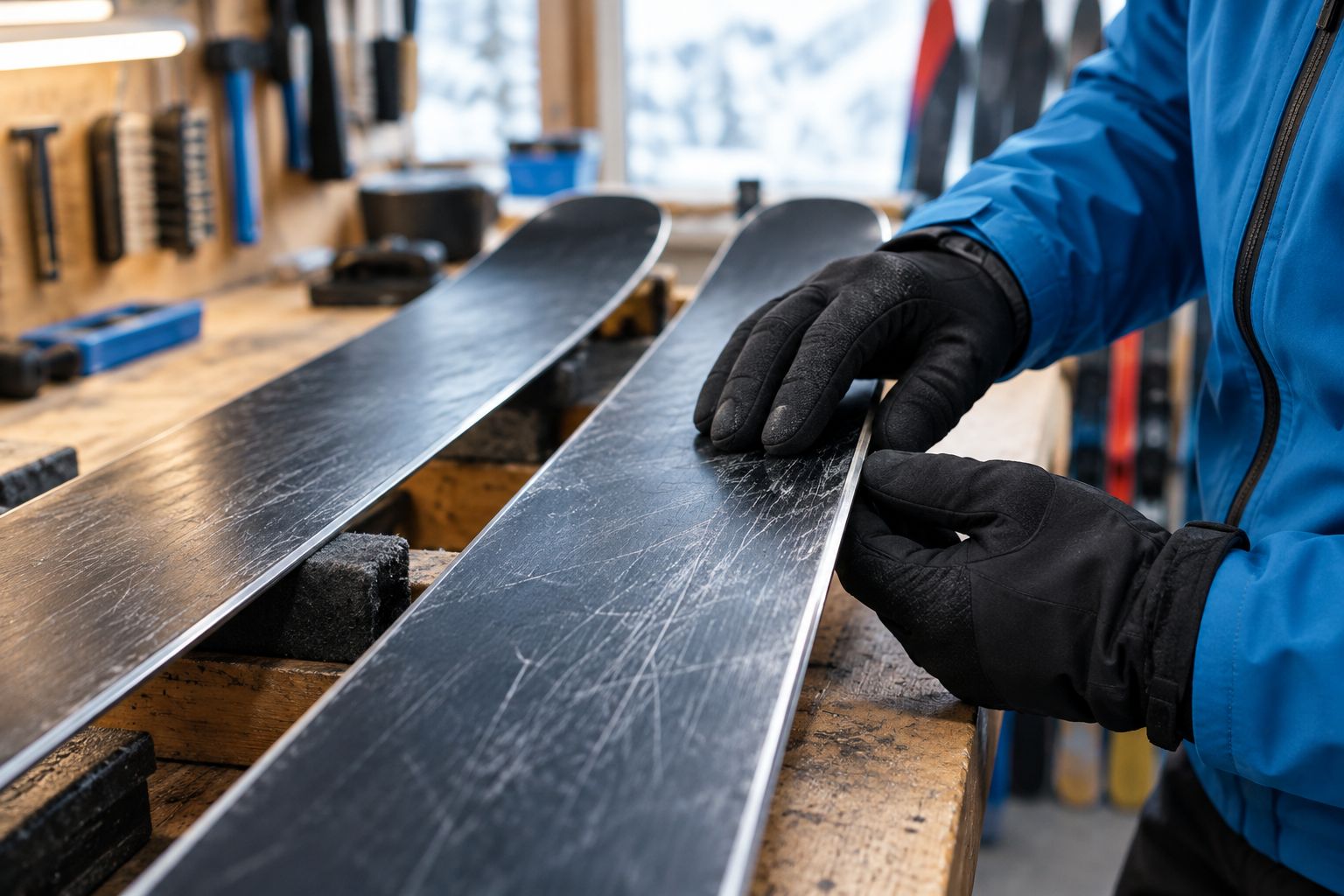
Inspect your own skis before deciding that a new pair is the answer. Look for damaged edges, base gouges, and obvious rust, then describe what you feel on snow. A ski that catches unpredictably or struggles to hold an edge needs assessment; its behavior alone does not identify the cause.
Skiboulder offers tuning alongside rentals and retail equipment. Ask a technician to distinguish routine edge and base maintenance from damage requiring repair. A demo can help you explore a different ski design, but it does not diagnose every problem with your current setup.
Tune differences also complicate comparisons. Do not attribute every change in grip or turn release to ski construction. Ask about the preparation of the demo pair and explain whether your own skis were recently serviced.
- Inspect bases and edges before the trip.
- Describe when a problem occurs, not just that a ski feels wrong.
- Ask whether damage needs repair before further use.
- Record known tune differences when comparing equipment.
A close inspection helps you describe visible damage without trying to diagnose it yourself. Leave binding work and judgments about whether damaged equipment is suitable for use to a qualified technician.
5. Compare skis with a repeatable on-snow routine
Write your impressions in a phone note or small notebook. Use the same familiar run where conditions and traffic permit, and compare skis at speeds you can control. Never push into unfamiliar terrain simply to discover a ski’s limits.
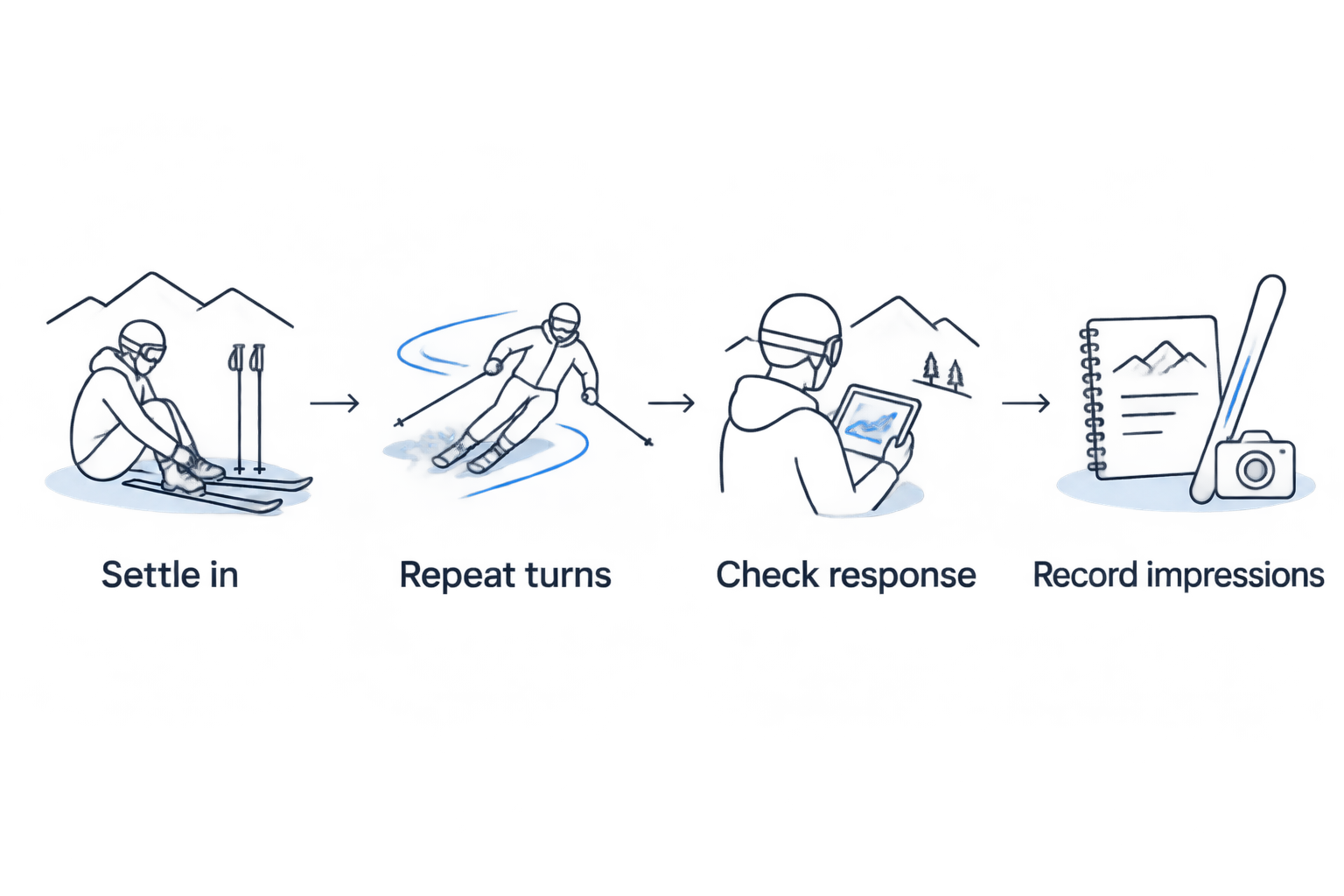
Use 3 runs as a trial framework, not a performance standard: one to settle into the equipment, one to repeat familiar turns, and one to check your main trial question. Add time when needed. If snow or visibility changes substantially, record that instead of treating the result as a direct comparison.
Compare 2 pairs with a clear contrast rather than switching through unrelated skis without notes. A longer equipment list is not useful if you cannot explain the differences afterward.
- Repeat a familiar turn shape on suitable terrain.
- Note turn initiation, edge hold, and turn release separately.
- Record fatigue and snow changes alongside ski impressions.
- Stop and seek help if the setup feels wrong or causes pain.
Use the same sequence for each pair. A consistent routine gives your observations structure without pretending that mountain conditions stay fixed.
6. Choose the next step from your notes
Review your notes before reading more equipment descriptions. If a ski felt easier to release but less settled at your normal speed, keep both observations. That trade-off matters more than whether the ski fits a fashionable category.
For a longer 2026 stay, the Demo Season Ski Lease describes taking a showroom ski out for the season. Its advantage is extended time with the equipment; its limitation for a short visitor is that a season-long arrangement does not match every itinerary. Confirm the agreement rather than assuming exchanges or other services are included.
If you are considering retail equipment, bring your trial notes into the selection conversation. Buying the same model name does not replace checking the specific length, binding setup, and suitability of the final equipment.
- Keep the observations that repeated across comparable runs.
- Identify which trade-offs you willingly accepted.
- Match a daily trial or seasonal arrangement to your stay.
- Confirm the final equipment setup before taking it skiing.
Compare equipment options for visiting skiers
Choose the format by the question you need answered. A rental supports a trip, a demo supports equipment evaluation, and your own skis provide a familiar reference—but each has limitations.
| Option | Best for | Main advantage | Key limitation |
|---|---|---|---|
| Daily demo | Visitors evaluating a different ski during a focused trip | Direct on-snow experience with the selected equipment | A short trial captures only the conditions you encounter |
| Demo season lease | Visitors spending an extended period in Colorado | More time to learn the equipment across the season | Requires an arrangement that fits a longer stay |
| Standard rental | Visitors primarily needing equipment for their trip | Focuses the selection conversation on suitable trip equipment | Does not necessarily provide a specific model for comparison |
| Your own skis | Visitors satisfied with their current setup | Familiar equipment provides a useful reference | Transport, condition, and suitability still need attention |
Choose a daily demo when your goal is evaluation, not simply access to skis. Choose familiar equipment when it already suits your trip and you have no clear question a demo would answer.
For every option, boot fit and binding compatibility remain separate checks. Neither a premium-sounding category nor ownership of the equipment removes those requirements.
Common mistakes visiting Colorado skiers make
Choosing for a storm instead of the itinerary
A soft-snow specialist is not automatically the right choice for a visit spent mostly on groomed runs. Tell the shop what you expect to ski, then discuss how much versatility you need if conditions change.
Treating ski length as the only fitting decision
Length matters, but shape, construction, skier ability, and intended terrain also affect suitability. Give the fitter your skiing history rather than asking for the same length in every model.
Using sore boots as a ski-performance test
Pain changes how you stand and move. Address boot problems first; otherwise, a ski that feels difficult to control might be responding to a compromised stance rather than revealing a design mismatch.
Assuming a demo includes every service
A demo description does not automatically establish accessories, exchanges, repairs, or extended use. Confirm the arrangement explicitly, and report damage or equipment concerns rather than trying to correct them yourself.
FAQ
What are demo skis for a Colorado trip?
Demo skis are skis you take on snow to evaluate how they suit your skiing. For a Colorado visit, choose them around your planned terrain and a specific question about performance rather than selecting only by model reputation.
Are demo skis better than standard rental skis?
Demo skis are the better choice when your purpose is to evaluate equipment before a retail decision. Standard rentals serve a different purpose: providing suitable equipment for your trip without necessarily targeting a particular model comparison.
Should I bring my own boots when trying demo skis?
Bring your own boots if they fit well and you intend to use them during the trial. The technician needs the actual boots to check compatibility and prepare the binding setup; a model name alone is not enough.
Does Skiboulder offer daily demos and a season demo lease?
Skiboulder lists a Demo Ski Package for a daily trial and a Demo Season Ski Lease for a season-long arrangement. Confirm the equipment, inclusions, and agreement directly before choosing between them.
How many runs should I take before judging demo skis?
Use 3 runs as an initial trial framework: settle in, repeat familiar turns, then check your main equipment question. This is a suggested routine, not a guarantee that every skier or condition can be assessed in that time.
Can a tune change how my current skis feel?
A tune can change edge engagement and glide, so maintenance deserves attention before you blame ski design. Describe your symptoms and have a technician assess edge condition, base condition, and any damage.
Should I buy skis immediately after a demo?
Make a retail decision only when your trial answers the question you started with. Keep notes on conditions, comfort, and performance trade-offs, then confirm the final ski length and binding setup separately.
One last thing
For your 2026 demo, write down what you disliked as carefully as what you liked. A ski that feels exciting on an early run but demands more effort than you want later has revealed something useful—not failed the test.
The goal is not to find the most demanding ski you can manage. It is to find equipment that supports the skiing you actually want to do.
Related guides
NEED A TUNE OR A FRESH SETUP?
– BETTER SKIING

- Professional Wintersteiger base grinds
- Precision edge sharpening
- Phantom Glide treatments
- Full binding safety checks
BOOK YOUR TUNE

KEEP YOUR GEAR
MOUNTAIN-READY
Keep your gear running
smooth — bring it to the experts.
0 comments