

Best ski base repair options ranked by damage severity

Best overall for exposed-core damage: professional core-shot repair. Best for shallow gouges: P-Tex filling. Best for superficial scuffs: leave the base intact and maintain the wax. This 2026 ski base repair guide from Skiboulder ranks the options by damage severity, so you know what needs filling, what needs inspection, and what does not need repair.
TL;DR
- Choose ski base repair by depth, exposed material, and edge condition—not scratch length alone.
- Professional core-shot repair is the best option for exposed-core damage without unresolved structural damage.
- Skiboulder provides ski base repair for Boulder skiers; bring damaged equipment in before choosing a repair method.
- Wax supports glide but does not replace missing base material or repair a displaced edge.
Why this matters
A long scratch can be superficial. A short puncture can expose the ski’s internal construction. Treating both with the same repair ignores the part that matters: whether the damage stays within the polyethylene base or reaches something underneath it.
For your 2026 equipment check, separate glide problems from missing material and structural damage. A dry-looking base needs a different response than a hole beside a bent edge. Choose the least invasive treatment that addresses the actual damage.
What makes the best ski base repair?
Use these criteria before choosing a repair method:
- Damage depth: Surface marks, missing polyethylene, and exposed internal material require different treatment.
- Damage location: A gouge surrounded by intact base differs from damage touching a steel edge or sidewall.
- Structural condition: Loose edges, cracks, and separated layers take priority over cosmetic appearance.
- Repair adhesion: The repair must bond to the material beneath it, not simply cover the opening.
- Base preservation: Grinding removes material. Filling every mark or repeatedly grinding for appearance is not the goal.
- Finished surface: A repaired area needs appropriate leveling and finishing so it does not stand proud of the surrounding base.
Ski base repair options at a glance
The order below follows increasing damage severity, not a single winner for every ski. A method near the bottom is not better for a shallow scratch.
| Rank and option | Best for | Standout feature | Key limitation |
|---|---|---|---|
| 1. Leave intact and wax | Superficial scuffs without missing material | Preserves the existing base | Does not fill a gouge |
| 2. Controlled base grinding | Surface irregularities assessed by a technician | Resurfaces the base and renews structure | Removes material; does not replace it |
| 3. P-Tex filling | Localized gouges contained within polyethylene | Fills missing base material | Basic drip repairs are unsuitable for exposed core or metal |
| 4. Professional core-shot repair | Localized damage exposing internal material | Addresses the repair interface beneath the base | Requires inspection; structural damage needs separate attention |
| 5. Base patch | Larger damaged areas needing replacement base material | Replaces a defined section rather than filling a broad cavity | More involved and dependent on surrounding material |
| 6. Structural assessment | Displaced edges, cracked sidewalls, or separated layers | Establishes whether the ski remains repairable | A smooth base alone cannot establish structural integrity |
1. Leave intact and wax: best for superficial scuffs
A superficial scuff marks the base without leaving a meaningful cavity. You do not need to fill every visible line. Clean and maintain the ski appropriately, then monitor the mark rather than removing sound base material to erase it.
Wax improves the running surface’s glide characteristics. It does not rebuild polyethylene, seal a structural opening, or straighten damaged steel.
Best for: Light surface marks with intact base material and no associated edge or sidewall damage.
Leave intact and wax pros:
- Preserves the existing base thickness.
- Avoids unnecessary filling and scraping.
- Keeps attention on function rather than cosmetic perfection.
Leave intact and wax cons:
- Leaves visible scratches in place.
- Cannot repair missing material or exposed internal layers.
Verdict: Skip filling superficial marks; maintain the base instead.
2. Controlled base grinding: best for surface irregularities
A base grind removes material to resurface the ski. Stone grinding also creates structure: a pattern in the running surface that helps manage water beneath the ski. Neither process is a substitute for filling a deep cavity.
Ask a technician to assess flatness and remaining base condition before choosing a grind. A scratch does not automatically justify resurfacing the whole ski, and deep damage generally needs repair before final finishing.
Best for: Bases needing assessed resurfacing or renewed structure, rather than replacement of missing material.
Controlled base grinding pros:
- Addresses suitable surface irregularities across the running surface.
- Provides a finishing step after compatible repairs.
- Allows structure to be considered alongside snow conditions.
Controlled base grinding cons:
- Removes a finite amount of base material.
- Cannot restore missing core material or correct a loose edge by itself.
For your 2026 tune, explain whether the problem is poor glide, an uneven surface, or impact damage. Those observations help distinguish routine maintenance from repair.
Verdict: Hold until a technician confirms grinding addresses the problem.
3. P-Tex filling: best for contained base gouges
P-Tex is the common name used for polyethylene ski-base repair material. It fills a gouge when the surrounding base and underlying repair surface are suitable. After the material bonds and cools, the excess is removed and the area is finished level.
A repair candle and a professional extrusion repair are not interchangeable processes. Dripped material is useful for suitable small repairs, but contamination and weak adhesion can cause a fill to pull out.
Best for: Localized gouges that remain within the polyethylene base, away from unresolved edge damage.
P-Tex filling pros:
- Replaces material missing from a contained gouge.
- Targets the damaged area rather than resurfacing the entire ski.
- Allows subsequent leveling and finishing.
P-Tex filling cons:
- Basic drip material does not reliably bond directly to exposed metal or core.
- Poor preparation leaves a repair vulnerable to separation.
- A filled surface can hide deeper damage if inspection comes first only after failure.
Do not enlarge a scratch simply to make room for a home repair. If you cannot identify what is visible at the bottom, stop before cutting or heating the area.
Verdict: Hold on home filling unless the damage is clearly contained within the base.
4. Professional core-shot repair: best for exposed internal material
A core shot penetrates the base and exposes material beneath it. The visible material is not necessarily wood; ski construction includes different layers. The repair approach depends on what is exposed and whether the surrounding structure remains intact.
Skiboulder ski base repair is best for Boulder skiers with exposed-core damage that needs professional assessment. The shop offers Core Shot Repair; the appropriate preparation, bonding material, and finishing method depend on the damaged ski.
Best for: Localized penetration through the base without unresolved structural failure.
Professional core-shot repair pros:
- Starts with assessment of the exposed material.
- Addresses bonding requirements beyond a basic candle fill.
- Allows nearby edge and sidewall damage to be considered together.
Professional core-shot repair cons:
- The repair method cannot be selected reliably from scratch length alone.
- Base repair does not automatically resolve damage to the ski’s internal structure.
- Further inspection is necessary when a previous repair repeatedly separates.
Keep exposed damage clean and dry before bringing the ski in. Avoid adding household glue, wax, or a temporary filler that obscures the repair surface.
Verdict: Hold the ski out of use until the exposed area is assessed.
5. Base patch: best for a larger damaged section
A base patch replaces a defined section of polyethylene with fitted base material. It is a specialist option when the damaged area is unsuitable for a straightforward fill. The surrounding base and underlying construction must support the repair.
A patch is not automatically the answer to every large scrape. A broad but shallow mark and a smaller torn-out section present different problems.
Best for: Larger areas of missing or damaged base where a technician determines that replacement material is appropriate.
Base patch pros:
- Replaces a defined damaged section.
- Provides an alternative to filling a broad cavity.
- Can retain otherwise usable equipment when the structure supports repair.
Base patch cons:
- Requires more preparation than a localized fill.
- Depends on the condition of surrounding and underlying material.
- Does not make a structurally compromised ski sound by itself.
Ask what the patch would bond to and whether the damage extends beyond the visible opening. The answer matters more than whether the finished repair disappears visually.
Verdict: Hold until specialist inspection confirms a patch is appropriate.
6. Structural assessment: best for edge or layer damage
A displaced steel edge, cracked sidewall, or separation between layers changes the decision. These are not simply empty spaces to fill. Covering them with polyethylene does not restore the connection between the ski’s components.
Stop skiing equipment with suspected structural damage and have it inspected. Some damage supports a specialist repair; other damage requires retiring the ski. Appearance alone does not establish the outcome.
Best for: Impact damage involving an edge, sidewall, or separated construction layers.
Structural assessment pros:
- Puts the ski’s integrity ahead of appearance.
- Separates base work from structural repair.
- Establishes whether further repair is appropriate.
Structural assessment cons:
- Does not guarantee the ski is repairable.
- Can lead to a recommendation to retire the equipment.
Verdict: Skip skiing until the structural damage is assessed.
How to inspect a damaged ski before your shop visit
For a 2026 shop visit, bring the ski as it is rather than hiding the damage under a fresh fill. Use this sequence to give the technician useful information without changing the repair surface.
- Dry the ski: Remove surface moisture and let the equipment dry.
- Inspect the base: Look for missing material and changes in what is visible beneath the running surface.
- Check the edge: Look for displacement, separation, and damage extending into the sidewall.
- Describe the impact: Explain what happened and whether handling changed afterward.
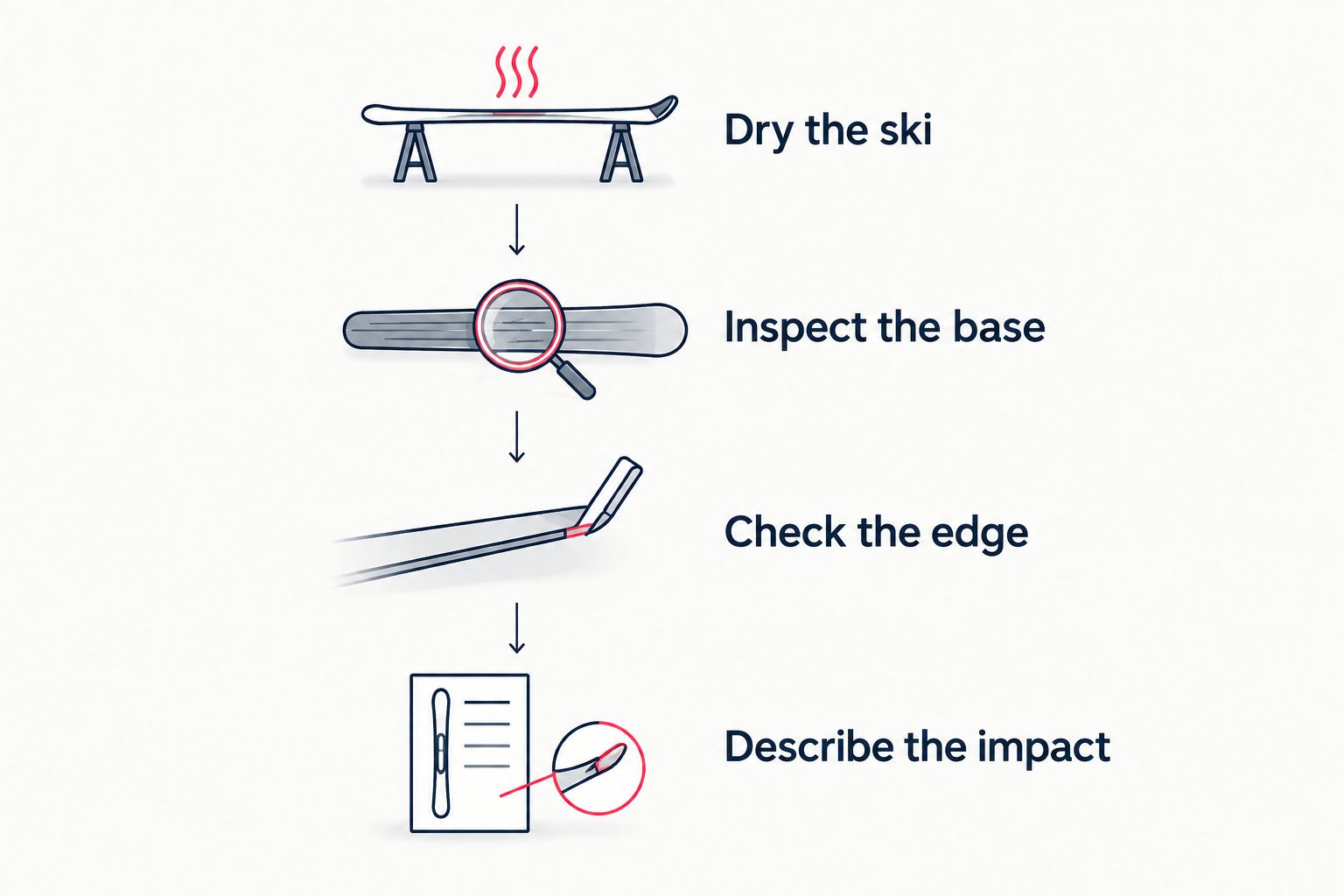
Do not flex a damaged area repeatedly to test it, pry at a loose edge, or cut away material before inspection. Note any previous repair in the same location. Repeated separation is useful diagnostic information, not a reason to keep adding filler.
Rental, lease, and replacement equipment
If you damage rental or season-lease skis, contact the supplying shop before attempting a repair. Follow its instructions rather than assuming a home fill is permitted. Report edge damage and exposed internal material clearly.
If inspection leads to replacement, choose retail equipment around your terrain, skiing style, boot fit, and binding compatibility. A new ski does not resolve an existing boot-fit problem. Keep the repair decision and the equipment-selection decision separate.
How the options are ranked
This 2026 ranking matches each method to damage depth, location, structural condition, adhesion requirements, and preservation of usable base material. It is a decision guide, not a claim that every method suits every ski.
Skiboulder offers tuning, repairs, rentals, boot fitting, and retail equipment. Ask for the damaged area to be assessed first; do not assume a routine tune includes every repair described here.
Which ski base repair should you choose?
Choose professional assessment when you see exposed internal material, edge displacement, or separation. Choose a localized fill for suitable contained gouges, and leave superficial marks alone when they do not require material replacement.
The default for an uncertain skier is inspection, not a repair candle. You do not need to diagnose the construction yourself before bringing the ski in.
FAQ
What is the best ski base repair for a deep gouge?
Professional assessment is the best starting point for a deep gouge. A contained polyethylene gouge, exposed-core damage, and edge-adjacent damage require different repair approaches.
Can I use P-Tex on a core shot?
Do not rely on a basic P-Tex candle fill directly over exposed core or metal. A professional repair needs preparation and bonding materials suited to the exposed surface.
Does ski wax repair scratches?
Wax does not replace missing ski-base material. It supports glide, while gouges that need filling require a separate repair.
Should every scratch in my ski base be filled?
No, superficial marks do not automatically need filling. Assess missing material, damage depth, and nearby edge condition before choosing treatment.
Can a base grind remove a deep scratch?
Grinding removes surrounding base material rather than replacing what is missing. Deep damage generally needs a suitable repair before final resurfacing.
Can I ski with a core shot?
Stop using the ski and have exposed internal material assessed. Keep the damaged area clean and dry rather than covering it with a temporary home fill.
What should I check before a ski base repair in 2026?
Check damage depth, visible internal material, edge displacement, and sidewall separation. Tell the technician about the impact and any earlier repair in the same place.
One last thing
A repair that looks smooth is not necessarily bonded well underneath. Before taking repaired equipment back on snow in 2026, ask what was repaired and whether any structural concern remains. Judge the repair by the condition of the ski, not just the appearance of the fill.
Related guides
NEED A TUNE OR A FRESH SETUP?
– BETTER SKIING

- Professional Wintersteiger base grinds
- Precision edge sharpening
- Phantom Glide treatments
- Full binding safety checks
BOOK YOUR TUNE

KEEP YOUR GEAR
MOUNTAIN-READY
Keep your gear running
smooth — bring it to the experts.
0 comments