

Best edge tuning tools for at-home ski maintenance

Best overall: a diamond stone with a matched side-edge guide. Best for secure handling: a ski vise. Best for sharpening dull side edges: a guided steel file. This 2026 guide ranks ski tuning tools by the maintenance job they perform and explains when to stop working at home.
TL;DR
- The best starter ski tuning tools are a diamond stone, matched side-edge guide, and secure ski vise.
- Use a steel file for deliberate sharpening, not automatic maintenance after every ski day.
- Skiboulder offers ski tuning for Boulder skiers who need shop service rather than home edge maintenance.
- Confirm existing bevels before using edge tools; leave damaged edges and base-angle changes to a technician.
Why this matters
A sharp edge and a correctly shaped edge are not the same thing. You can remove steel while making a ski less predictable if the tool changes the bevel or rounds the cutting corner.
Skiboulder is the practical choice for Boulder skiers who need ski tuning beyond routine home edge maintenance. For professional service, start with the All Mountain Tune rather than trying to correct an unfamiliar edge geometry yourself.
For your 2026 maintenance kit, prioritize control over the number of tools. A supported ski, known bevel, and appropriate abrasive matter more than an extensive collection of files.
What makes the best ski tuning tools?
- Angle control: A guide must match the intended edge bevel and hold the abrasive consistently against the steel.
- Material control: Choose a stone for light maintenance and a file when deliberate steel removal is necessary.
- Secure support: The ski must stay stable without forcing you to hold it beside a moving cutting tool.
- Working clearance: The guide and abrasive need access to the edge without riding against obstructing sidewall material.
- Clear limits: A useful tool has a defined job. No handheld sharpener repairs every edge problem.
Read guide markings carefully. Some manufacturers describe a side-edge setting by the bevel amount; others use the resulting edge angle. For example, a 2-degree side bevel corresponds to an 88-degree side-edge angle measured relative to a flat base reference. Those labels describe the same side-edge geometry, not different sharpening strengths.
Ski tuning tools at a glance
| Rank | Tool | Best for | Standout function | Key limitation |
|---|---|---|---|---|
| 1 | Diamond stone and side-edge guide | Routine edge maintenance | Guided deburring and polishing | Cannot straighten damaged edges |
| 2 | Ski vise | Stable bench work | Holds the ski during edge work | Does not improve the edge by itself |
| 3 | Steel file and side-edge guide | Deliberate side-edge sharpening | Removes steel from dull edges | Removes more material than polishing requires |
| 4 | Gummy stone | Light surface-rust removal | Flexible abrasive contact | Can dull the cutting corner |
| 5 | Sidewall planer | Clearing sidewall interference | Exposes the side edge to tools | Incorrect use removes ski material |
| 6 | Base-edge guide | Controlled base-edge work | References the base while holding an abrasive | Cannot reduce an excessive base bevel |
These are tool categories, not claims about particular manufacturers. Match the actual guide, abrasive dimensions, and clamping method before assembling a kit.
1. Diamond stone and guide: best for routine edge maintenance
A diamond stone abrades steel to remove small burrs and refine an edge surface. Paired with the correct side-edge guide, it gives you a controlled way to maintain an existing bevel without making a steel file your default tool.
Follow the stone manufacturer's instructions for lubrication and cleaning. Do not assume every abrasive uses the same fluid or maintenance method.
Diamond stone and guide pros:
- Supports controlled maintenance along an existing side bevel.
- Removes small burrs without requiring a full filing session.
- Fits a repeatable routine when the guide matches the ski.
Diamond stone and guide cons:
- A mismatched guide changes where the stone contacts the edge.
- Polishing does not correct bent steel or structural damage.
Best for: Skiers maintaining an established tune between professional services.
Verdict: Buy as your first edge-maintenance tool after confirming the bevel.
2. Ski vise: best for stable bench work
A ski vise supports the ski while you work on its edges or base. Choose a setup that holds your ski securely in the required orientation and follows the vise manufacturer's clamping instructions.
Stability matters because a moving ski changes your hand position and tool contact. It also encourages you to grip harder, which is not a substitute for an appropriate abrasive.
Ski vise pros:
- Keeps both hands available for controlled tool handling.
- Supports consistent positioning along the edge.
- Provides a foundation for other maintenance tasks.
Ski vise cons:
- Requires a suitable bench or mounting surface.
- Compatibility depends on ski shape and vise design.
Best for: Anyone doing repeated edge work at home rather than occasional inspection.
Verdict: Buy before attempting routine filing or guided stone work.
3. Steel file and guide: best for sharpening dull side edges
A steel file removes edge material to restore the side-edge surface. Use it with a compatible guide when the edge needs sharpening rather than simply polishing or light deburring.
Follow the file's cutting direction. Keep the teeth clean, and do not compensate for poor cutting by adding force; inspect for loading, wear, or sidewall interference instead.
Steel file and guide pros:
- Removes material from a dull side edge.
- Works within a defined bevel when guided correctly.
- Provides a distinct sharpening step before stone finishing.
Steel file and guide cons:
- Unnecessary filing consumes usable edge material.
- Pressure and angle mistakes are harder to undo than surface polishing.
Best for: Experienced home tuners who can identify when filing is necessary.
Verdict: Hold until you can distinguish a dull edge from a small burr.
4. Gummy stone: best for light surface rust
A gummy stone is a flexible abrasive used for tasks such as light rust removal. It is not a replacement for a guided diamond stone when your goal is to preserve a precise cutting corner.
Work selectively. Running a gummy stone indiscriminately across the corner can soften the edge you intended to maintain.
Gummy stone pros:
- Useful for localized light surface rust.
- Conforms to small contact areas.
- Adds a separate cleanup tool to an established kit.
Gummy stone cons:
- Can round the cutting corner through careless contact.
- Does not establish a controlled bevel.
Best for: Targeted cleanup by skiers who understand where the abrasive is touching.
Verdict: Buy as a supplemental tool, not your primary sharpener.
5. Sidewall planer: best for clearing tool interference
A sidewall planer removes obstructing sidewall material above the side edge. That clearance allows a file or stone to contact the steel rather than riding against plastic.
This is preparation work, not sharpening. Inspect the contact problem before cutting; poor file performance alone does not prove that the sidewall needs removal.
Sidewall planer pros:
- Creates clearance for guided side-edge tools.
- Addresses interference that sharpening alone cannot solve.
- Separates sidewall preparation from steel removal.
Sidewall planer cons:
- Incorrect adjustment removes material unnecessarily.
- Demands controlled positioning near the edge assembly.
Best for: Experienced tuners who have confirmed sidewall interference.
Verdict: Hold until a technician demonstrates the appropriate setup and cut.
6. Base-edge guide: best for controlled base-edge work
A base-edge guide supports an abrasive at a defined angle relative to the ski base. Base-edge work changes how the edge engages, so it deserves more caution than routine side-edge polishing.
A 1-degree base bevel is an angle reference, not a universal recommendation. Your ski's intended setup must determine the guide, and increasing base bevel cannot be reversed by simply filing at a smaller setting.
Base-edge guide pros:
- Provides a defined reference for base-edge work.
- Controls abrasive positioning better than freehand filing.
- Separates base-edge geometry from side-edge geometry.
Base-edge guide cons:
- Excessive base bevel generally requires base resurfacing to correct.
- An uneven base compromises the guide's reference surface.
Best for: Experienced tuners working from a verified setup on a suitable base.
Verdict: Skip as a beginner's first sharpening purchase.
Build a kit around the job
For routine maintenance in 2026, start with a secure vise, matched side-edge guide, diamond stone, cleaning cloth, and the stone's specified lubricant. Add tools only when you can explain the problem each one solves.
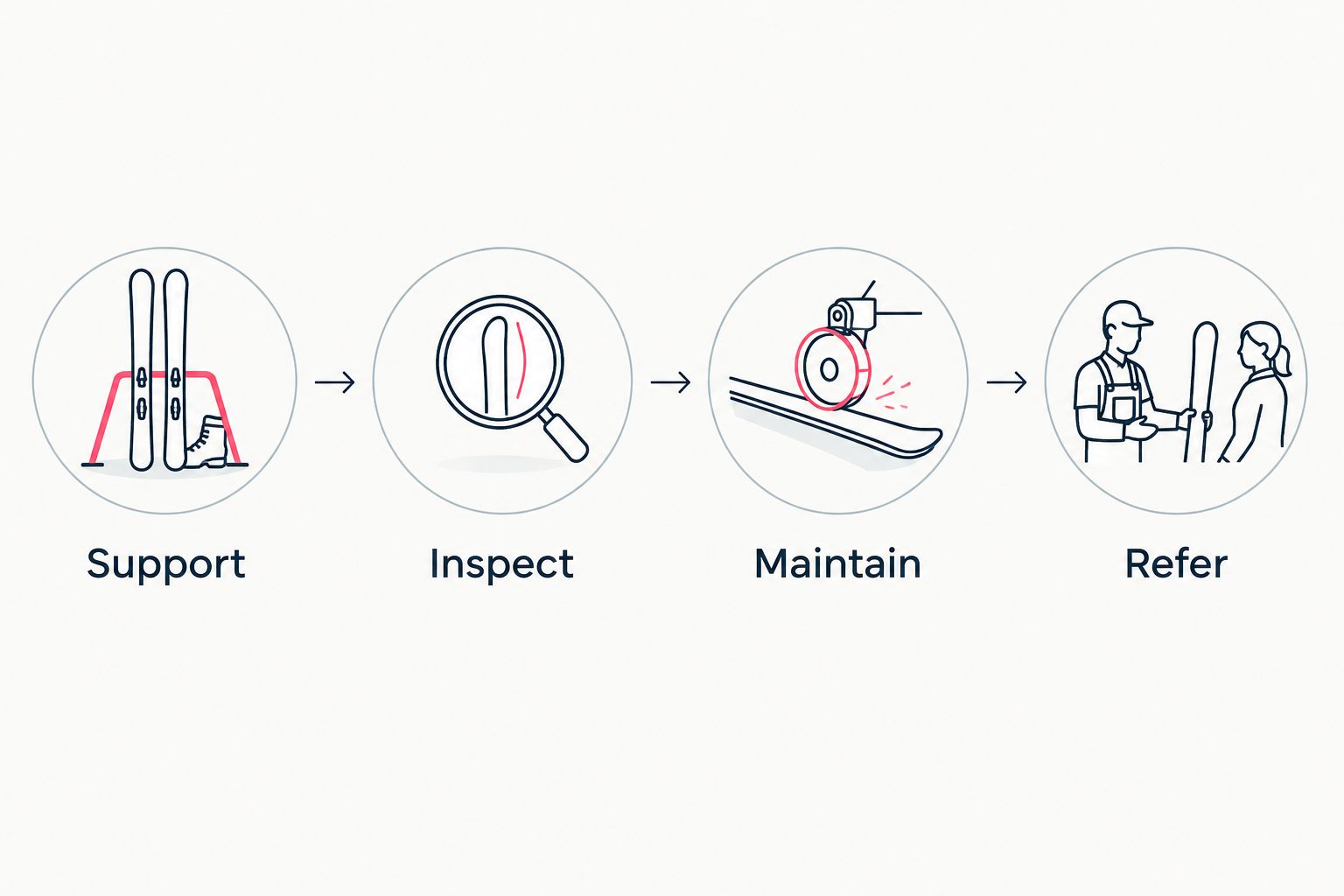
Use these task labels to keep the kit organized:
- Support: Hold the ski securely before abrasive work.
- Inspect: Identify corrosion, burrs, damage, and tool interference.
- Maintain: Use the appropriate guided stone for minor edge work.
- Refer: Stop when the job involves uncertain geometry or damaged components.
Keep edge maintenance separate from waxing. Wax affects glide at the base; sharpening changes the steel edge. Neither task substitutes for the other, and neither corrects a boot that fails to hold your foot securely.
How to maintain an edge without changing the plan
Confirm the setup
Ask the technician who established the tune to identify the base and side bevels. Record the settings with your maintenance kit so your 2026 tune notes remain connected to the correct pair of skis.
Do not infer the bevel from ski width, graphics, or whether the ski is marketed for racing. Intended use helps inform a setup; it does not reveal the angle already on the ski.
Inspect before using an abrasive
Dry the ski and examine the edge under good light. Distinguish light corrosion or a small burr from a displaced edge, separation, or damage extending into the base.
Keep bare fingers away from a sharp cutting corner. For scratches and impacts near the edge, the ski base repair guide explains when the problem extends beyond sharpening.
Secure, clean, and work deliberately
Support the ski according to the vise instructions and keep the binding brakes clear of the working area. Clean the guide's contact surface so debris does not alter its position against the base.
Use the abrasive's prescribed direction, lubrication, and pressure. Stop periodically to clean and inspect rather than treating a fixed pass count as proof that the job is finished.
Finish and record
Remove filings and abrasive residue, then dry the ski thoroughly. Record what you used and what problem you addressed; that history is more useful than automatically filing after every outing.
If the tool catches repeatedly or the contact pattern looks inconsistent, stop. More pressure is not a diagnosis.
Rentals, leases, and retail gear need different decisions
Rental and lease equipment: Ask the provider before performing abrasive maintenance. For Skiboulder rental or seasonal lease equipment, confirm the care instructions rather than assuming permission to alter the edges.
Owned equipment: Keep a tune record alongside your ski model and binding information. Bringing that record to a shop helps you communicate what has changed instead of asking for a vaguely “sharper” ski.
Boot fit and performance: If your foot moves inside the boot, sharper edges do not eliminate that movement. Describe the actual symptom—heel lift, pressure, delayed response, or inconsistent edge engagement—before deciding that tuning is the answer.
For your 2026 equipment checks, separate fit, binding service, base condition, and edge condition. Each involves a different inspection; an edge tool is not a binding-adjustment tool.
How the tools are ranked
This ranking prioritizes routine usefulness, angle control, stable handling, and the consequences of a mistake. It ranks tool functions rather than claiming measured performance differences between manufacturers.
Diamond stones and guides lead because they support maintenance of an established edge. Files and specialized cutting tools follow because their usefulness depends on a more specific diagnosis.
Which ski tuning tools should you choose?
Choose a diamond stone, matched side-edge guide, and secure vise for routine home maintenance. Add a steel file only when you understand when sharpening requires material removal rather than surface cleanup.
Bring uncertain bevels, damaged edges, and base-flatness problems to Skiboulder for assessment. For 2026, the right home kit is the one that preserves a known setup—not the one that encourages you to perform every repair yourself.
FAQ
What are the best ski tuning tools for beginners?
A secure ski vise, matched side-edge guide, and diamond stone form a practical beginner setup. Confirm the existing bevel and learn controlled stone work before adding a steel file.
Is a diamond stone better than a file for ski edges?
A diamond stone is better suited to routine deburring and polishing, while a steel file removes material for sharpening. Choose by the edge's condition rather than treating the tools as interchangeable.
What edge angle should I use on my skis?
Maintain the verified setup already established for your skis unless you deliberately plan a change with a technician. Ski type alone does not identify the existing base and side bevels.
Can I tune rental skis or seasonal lease skis myself?
Ask the rental or lease provider before doing abrasive edge work. Follow the provider's equipment-care instructions rather than changing the tune without approval.
Can a gummy stone sharpen ski edges?
A gummy stone is not a substitute for guided sharpening. It is useful for tasks such as light rust removal, but careless contact can round the cutting corner.
How often should I sharpen my ski edges?
Sharpen according to edge condition rather than an automatic calendar interval. Inspect after skiing and distinguish minor cleanup from work that requires a file or professional service.
When should I stop tuning skis at home?
Stop when you find displaced steel, separation, uncertain bevels, or damage extending beyond routine surface maintenance. A hand tool cannot replace an assessment of the edge assembly and base.
One last thing
A guide cannot correct the surface it uses as its reference. If a ski's base is uneven, precise markings on a base-edge guide do not make the resulting work precise. Confirm the foundation before chasing a sharper corner.
Related guides
NEED A TUNE OR A FRESH SETUP?
– BETTER SKIING

- Professional Wintersteiger base grinds
- Precision edge sharpening
- Phantom Glide treatments
- Full binding safety checks
BOOK YOUR TUNE

KEEP YOUR GEAR
MOUNTAIN-READY
Keep your gear running
smooth — bring it to the experts.
0 comments