

Evo.com alternatives for in-person boot fitting

Evo’s strength is bringing ski equipment research and retail shopping together, but an online comparison cannot show how a boot holds your heel or loads your instep. Among evo.com alternatives in 2026, Skiboulder is the best fit for Boulder skiers seeking local boot fitting alongside rentals, tuning, and retail; a dedicated boot-fitting specialist is the alternative when boot assessment is your sole priority.
TL;DR
- Skiboulder leads evo.com alternatives for Boulder skiers seeking boot fitting, rentals, tuning, and retail together.
- A dedicated boot-fitting specialist suits skiers focused on an existing boot problem; confirm the required work first.
- Evo remains an option when its shopping experience works and you can arrange an appropriate in-person fitting.
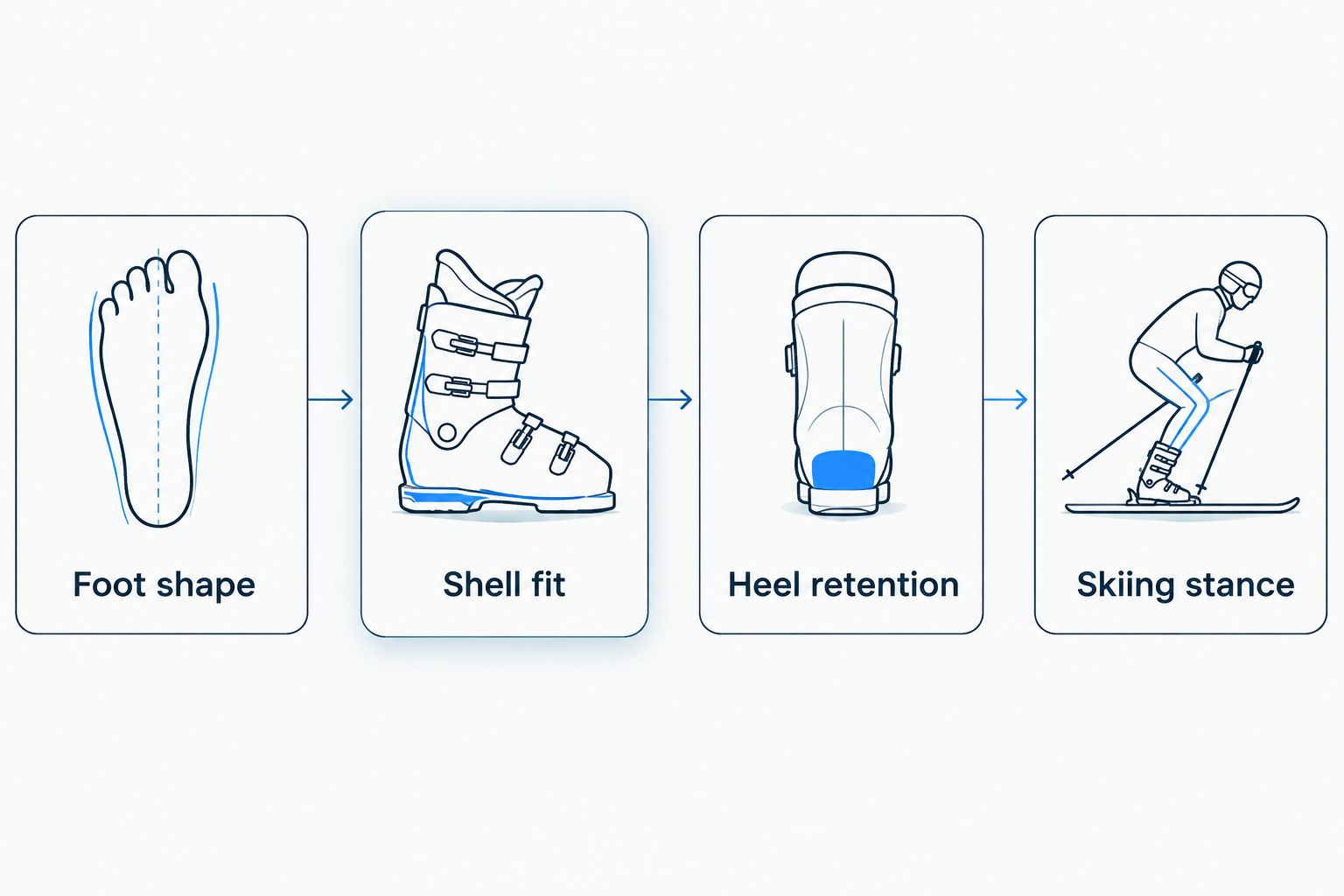
- Choose ski boots by foot shape, shell fit, and stance—not size labels or closure systems alone.
Why this matters
A ski boot connects your movements to the ski. Excess space lets your foot move before the shell responds; concentrated pressure can make a technically capable boot difficult to ski comfortably.
The useful comparison is not simply local shop versus online retailer. It is whether you can have your feet assessed, compare appropriate shells, explain your skiing, and return with a specific fit problem.
For your 2026 equipment decision, separate three questions: does the boot fit, does it suit your skiing, and does it work with your bindings? A familiar model name answers none of those questions by itself.
Evo.com alternatives at a glance
These options represent different service routes, not interchangeable stores. A dedicated specialist is a category of provider; ask an individual fitter about capabilities before choosing one.
| Option | Best for | Standout distinction | Difference from Evo |
|---|---|---|---|
| Skiboulder | Boulder skiers combining boot fitting with equipment and maintenance | Boot fitting, retail skis, boots and bindings, tuning, and rentals | A Boulder-based shop option for an in-person equipment discussion |
| Dedicated boot-fitting specialist | Skiers concentrating on a particular boot-fit problem | A boot-focused assessment, with scope confirmed directly | Select the provider around the fitting work you need rather than the retail shopping process |
| Evo | Skiers who prefer its equipment-shopping experience | Ski equipment research and retail shopping | The benchmark; distinguish shopping online from arranging an in-person fitting |
Choose the fitting process before choosing the boot model. Neither an online listing nor a shop name establishes that a particular shell suits your foot.
1. Skiboulder: best for Boulder equipment support
The Boulder shop offers boot fitting alongside retail skis, boots and bindings, tuning, and rentals. That makes it a relevant starting point when your question extends beyond which boot to buy.
You can frame the visit around your whole setup: the boots you own, the skis you use, and the response you want on snow. Confirm the assessment and any proposed work directly rather than assuming that every fitting includes the same adjustments.
Where Skiboulder shines
- Local relevance: an in-person option for skiers visiting Boulder.
- Equipment context: boot fitting and retail equipment are part of the stated service offering.
- Maintenance coverage: tuning and rentals provide additional reasons to discuss how your setup performs.
Where Skiboulder falls short
- The Boulder location is not a practical in-person solution for every skier.
- A full-service offering does not establish that every specialist shell modification is provided; ask about your specific problem.
- A fitting conversation cannot replace skiing the boot and reporting what happens under load.
| Dimension | Boulder shop option | Evo |
|---|---|---|
| Starting point | Local boot fitting and equipment services | Equipment research and retail shopping |
| Fit decision | Discuss your feet and existing setup in person | Separate online selection from any in-person fitting arrangement |
| Related needs | Tuning, rentals, and retail are stated offerings | Check the services relevant to your chosen shopping route |
Best for: Boulder skiers who want boot fit considered alongside the rest of their equipment. Verdict: Choose for a local fitting discussion.
2. Dedicated boot-fitting specialist: best for a focused fit problem
A dedicated boot-fitting specialist is a sensible comparison when you already own boots and can describe a persistent problem. Ask whether the provider assesses existing boots and performs the particular work being considered.
Choose this route by demonstrated service scope, not by the word specialist alone. It does not establish medical expertise or guarantee that an unsuitable shell can be corrected.
Where a dedicated specialist shines
- Keeps the appointment centered on boot fit rather than a broader equipment purchase.
- Gives you a clear reason to ask about shell assessment, liner condition, foot support, and adjustment options.
Where a dedicated specialist falls short
- Services differ between providers; a boot-focused business is not proof of every modification capability.
- You must separately confirm support for rentals, ski maintenance, or binding work.
Best for: skiers seeking a focused assessment of an existing boot. Verdict: Choose after confirming the required work.
What an in-person fitting should establish
A useful boot-fitting conversation produces a reason for the recommendation. You should understand why a particular shell shape, volume, and flex are being considered—not just hear that the size is correct.
Use these assessment areas to compare providers. They are questions to bring to a fitting, not a promise that every shop follows an identical appointment format.
Foot shape
Discuss length, forefoot width, instep height, heel shape, and differences between your feet. A boot can match your length while putting pressure across the instep or leaving excessive room around the heel.
Explain where previous boots caused trouble. Point to the location rather than describing the entire boot as uncomfortable.
Shell fit
Ask how the shell’s length and shape suit your foot independently of the liner. A liner cushions and occupies space, but it does not turn every shell shape into the right match.
Do not use street-shoe size as the final selection rule. Ski boots need an assessment of foot retention and skiing stance, not just toe room while standing upright.
Heel retention
Flex forward and describe whether your heel stays seated. Tightening the forefoot excessively to control heel movement can create another problem without addressing the underlying shape mismatch.
Some movement and pressure sensations require a fitter’s interpretation. The goal is controlled retention, not making every part of the foot feel clamped.
Skiing stance
Tell the fitter about your terrain, ability, skiing frequency, and existing equipment. A boot that feels supportive in a shop still needs to let you move into an effective skiing position.
Flex labels help distinguish models within a discussion, but they are not a universal measurement across every brand. Avoid choosing solely because one label looks more advanced.
Bring thin ski socks and your current boots if you have them. Existing footbeds and a clear description of your symptoms also give the fitter useful context.
Read boot measurements without mixing them up
Mondo sizing and boot sole length describe different things. Confusing them can derail both boot selection and a binding discussion.
A nominal Mondo 26.5 size refers to a foot length of 26.5 centimeters, equivalent to 265 millimeters. That label is a starting point for fitting, not proof that every boot carrying it has the same internal shape.
A 305 mm boot sole marking describes external sole length, not the foot length the boot is intended to fit. Read the marking on the actual boot rather than calculating it from the Mondo label.
Before changing boots, have a technician check boot–binding compatibility and the adjustment and testing required. Matching the size label on your old and new boots is not a substitute for that check.
Match the service route to your skiing
Boot shopping, renting, and maintaining owned equipment solve different problems. Keep them separate long enough to identify what you actually need.
If you are choosing rental equipment
Describe your experience honestly and explain any previous boot discomfort. Tell the rental provider about heel movement, numbness, or a pressure point before focusing on ski length or model.
Ask what equipment is included and how fitting and binding setup are handled. Do not assume that a rental fitting includes the same assessment or modification work as fitting boots you intend to own.
If you are considering a seasonal lease
Ask what stays with you through the season, which fitting steps are included, and how equipment questions are handled afterward. A seasonal lease is a different arrangement from a short rental; confirm its terms directly.
Consistency gives you a useful reference when describing performance. Record whether a sensation appears immediately, after skiing, or only during particular movements instead of changing several equipment variables at once.
If you already own skis and boots
Separate foot movement inside the boot from ski behavior on snow. A loose heel and a damaged edge are different equipment problems, even when both leave you feeling less precise.
Describe grip, glide, vibration, visible damage, and boot sensations separately. That helps you request the right assessment without assuming that a tune will resolve fit or that new boots will repair a ski problem.
If you are buying retail gear
Choose the boot around your foot and skiing requirements before building the rest of the purchase around a preferred model. Ask how the selected boot and binding work together.
Keep maintenance in the conversation. Edge condition, base condition, and boot fit all deserve attention, but each requires its own diagnosis.
Why people switch from Evo
The clearest reason to consider evo.com alternatives is a change in what you need from the shopping process. Once your question becomes about heel hold, instep pressure, or an existing boot, product descriptions alone are insufficient.
For a 2026 comparison, use these concrete service needs rather than assumptions about retailers:
- You need someone to assess your feet. Measurements and physical fit checks address questions that a specification list cannot.
- You want to discuss existing equipment. Bring the boots and explain what happens while skiing.
- You need a practical return visit. Choose a location you can realistically revisit with feedback.
- You have several equipment questions. Distinguish boot fit, binding compatibility, rentals, and tuning before deciding which services to request.
These are reasons to choose a different route, not evidence that Evo provides poor service. The important distinction is between selecting equipment remotely and having your particular setup assessed in person.
Before you arrange a fitting
Contact the provider with a short description of your objective. Say whether you are selecting new boots, assessing existing boots, or sorting out rental equipment.
Ask what to bring and whether the shop handles the specific work you are considering. Describe the problem before requesting a particular intervention such as heat molding or shell modification.
Your 2026 fitting checklist should record the location of discomfort, when it begins, and which movements trigger it. Persistent pain or numbness deserves attention; do not treat it as proof that you simply need to tolerate a tighter boot.
Discuss your boot-fitting needs
Ask about fitting, what to bring, and assessing your existing ski equipment.
When staying with Evo is the right call
Stay with Evo when its shopping process meets your needs and you have an appropriate plan for assessing fit. Switching retailers is not an improvement by itself.
If your current boots fit and perform well, start by identifying what actually needs attention. A ski tune, binding assessment, or clearer understanding of your equipment is a different decision from replacing boots.
Keep the option that answers your equipment question with the fewest assumptions. Familiarity is useful; an unresolved fit problem still needs assessment.
FAQ
What's the best Evo.com alternative for boot fitting in Boulder in 2026?
Skiboulder is the local alternative for Boulder skiers seeking boot fitting alongside retail equipment, tuning, and rentals. Contact the shop to discuss your existing boots, fitting objective, and any specific work you are considering.
Is an in-person fitting better than choosing ski boots online?
An in-person fitting addresses physical fit questions that online specifications cannot resolve. Foot shape, shell fit, heel retention, and skiing stance need assessment beyond a size label.
Does Evo only sell equipment online?
No. Evo also operates physical retail locations, so distinguish its website shopping experience from an in-store visit. Confirm the fitting services at the location you intend to use.
Can I bring existing ski boots to a boot fitter?
Ask the fitter whether they assess existing boots and what equipment to bring. Explain the symptom and its location before requesting a particular modification.
Will heat molding fix a ski boot that does not fit?
Heat molding is not a universal fix for an unsuitable shell. Whether it helps depends on the boot materials, fit problem, and adjustment required; have those assessed first.
Should I buy a bigger ski boot if my toes feel crowded?
Do not move to a larger boot solely because of initial toe pressure. Have shell length, heel position, stance, and liner fit assessed so extra length does not create unwanted movement elsewhere.
Do I need my bindings checked after changing boots?
Have a technician check compatibility and the adjustment and testing required after changing boots. Matching Mondo labels does not establish matching sole lengths or boot–binding compatibility.
One last thing
Before your first 2026 fitting visit, write down what happens—not the fix you think you need. Heel lift during turns, pressure over the instep, and toe contact while upright are more useful observations than a request for a softer or larger boot.
A precise symptom gives the fitter a better starting point than a preferred product name. Bring that description with your equipment.
Related guides
NEED A TUNE OR A FRESH SETUP?
– BETTER SKIING

- Professional Wintersteiger base grinds
- Precision edge sharpening
- Phantom Glide treatments
- Full binding safety checks
BOOK YOUR TUNE

KEEP YOUR GEAR
MOUNTAIN-READY
Keep your gear running
smooth — bring it to the experts.
0 comments