

Best ski boots for intermediate to advanced skiers

Best overall fitting candidate: Atomic Hawx Prime 120 S BOA GW for strong all-mountain skiers. Best women’s all-mountain candidate: Atomic Hawx Prime 105 S BOA W GW. Best freestyle candidate: Dalbello iL MORO 90 3DWRAP. The best ski boots for intermediate to advanced skiers in 2026 are the ones that hold your feet securely while letting you flex into a balanced skiing stance.
TL;DR
- The best ski boots for intermediate to advanced skiers match foot shape, usable flex, and terrain—not ability labels alone.
- Atomic Hawx Prime 120 S BOA GW is the first fitting candidate for strong all-mountain skiers.
- Atomic Hawx Prime 105 S BOA W GW suits a women’s all-mountain fitting shortlist.
- Dalbello iL MORO 90 3DWRAP belongs on a freestyle shortlist, not every advanced skier’s shortlist.
- Skiboulder offers Boulder ski boot fitting; confirm fit and binding compatibility before choosing.
Why boot fit matters more than the ranking
A boot transfers movement from your lower leg and foot to the ski. Excess space delays that transfer; concentrated pressure makes it harder to stay relaxed and balanced. Neither problem disappears because you choose a more demanding model.
Skiboulder is best for Boulder skiers who want ski boot fitting alongside retail equipment and tuning services. Bring your current boots and explain what happens on snow when you visit Skiboulder. “My heel lifts when I initiate a turn” gives a fitter more useful information than “I need an advanced boot.”
Use this 2026 shortlist to choose what to try, not to bypass a fitting. A less demanding boot that matches your anatomy is a better choice than a powerful boot that prevents you from moving correctly.
What makes the best intermediate-to-advanced ski boots?
These criteria determine whether a boot belongs on your feet:
- Shell shape: Match the shell to foot length, forefoot shape, heel shape, and instep height. A closure system cannot correct every shape mismatch.
- Heel retention: Your heel should stay secure as you flex forward without requiring excessive closure tension.
- Usable flex: You should be able to move the cuff deliberately while maintaining balance, rather than folding through it or fighting it.
- Pressure distribution: Firm contact is useful; isolated pain, numbness, and tingling are not performance features.
- Terrain match: All-mountain skiing and repeated park movements place different demands on support and movement.
- Binding compatibility: The actual boot sole and binding must be compatible, correctly adjusted, and checked by a qualified technician.
Flex numbers help organize a fitting conversation, but they are not a standardized cross-brand measurement. A 120 flex label does not establish that every boot carrying it bends identically.
Best ski boots at a glance
| Rank and boot | Best for | Standout feature or focus | Key limitation |
|---|---|---|---|
| 1. Atomic Hawx Prime 120 S BOA GW | Strong all-mountain skiers | All-mountain design with BOA closure | Wrong choice if you cannot flex it effectively or the shell shape mismatches your foot |
| 2. Atomic Hawx Prime 105 S BOA W GW | Skiers seeking a women’s all-mountain boot | Women’s all-mountain design with BOA closure | Women’s labeling does not establish a match for your foot or lower leg |
| 3. Dalbello iL MORO 90 3DWRAP | Freestyle-focused intermediates | Park-oriented design | Not the default recommendation for skiers seeking substantial cuff support |
These are distinct fitting paths, not interchangeable upgrades. The first comparison is between your foot and the shell; the second is between the boot’s intended use and your skiing.
1. Atomic Hawx Prime 120 S BOA GW: best for strong all-mountain skiing
The Atomic Hawx Prime 120 S BOA GW is an all-mountain ski boot with a BOA closure system. Start here if your skiing calls for substantial support and you can demonstrate controlled forward movement in the boot during a fitting.
The important question is not whether you identify as advanced. It is whether this particular boot lets you stay centered while your ankle and lower leg move through a useful range. A boot that leaves you bracing against the back of the cuff is not helping.
Atomic Hawx Prime 120 S BOA GW pros:
- Its stated all-mountain purpose matches a resort-focused shortlist.
- BOA provides a dial-operated closure adjustment.
- It is a relevant fitting candidate when support is a priority.
Atomic Hawx Prime 120 S BOA GW cons:
- The fit remains dependent on your foot and lower-leg shape.
- A demanding flex is a disadvantage if you cannot move the cuff effectively.
- BOA adjustment does not replace shell assessment or resolve every pressure point.
Best for: Strong intermediate-to-advanced all-mountain skiers whose fit and movement support this choice.
Verdict: Buy only after confirming shell fit, heel retention, and usable forward flex.
2. Atomic Hawx Prime 105 S BOA W GW: best for women’s all-mountain use
The Atomic Hawx Prime 105 S BOA W GW is a women’s alpine boot intended for all-mountain skiing. It belongs on your shortlist when you want to assess that combination of fit, support, and dial-operated closure.
Do not treat the 105 label as a universal ability requirement. Body size, ankle mobility, lower-leg shape, and how you apply pressure all affect whether the boot works. Compare movement and pressure distribution rather than choosing by the number alone.
Atomic Hawx Prime 105 S BOA W GW pros:
- Its stated purpose covers all-mountain skiing.
- BOA allows closure tension to be adjusted with a dial.
- It offers a women’s-specific candidate for an in-person comparison.
Atomic Hawx Prime 105 S BOA W GW cons:
- A women’s designation does not guarantee suitable cuff contact or foot shape.
- Its flex label cannot predict your experience without trying it.
- Increasing closure tension is not a sound fix for an oversized shell.
Best for: Skiers seeking a women’s all-mountain boot who achieve secure, evenly distributed contact in this model.
Verdict: Buy if the shell and cuff fit your anatomy and you can flex without heel lift.
3. Dalbello iL MORO 90 3DWRAP: best for freestyle-focused skiing
The Dalbello iL MORO 90 3DWRAP is described as a freestyle ski boot for park riding. That makes it a different recommendation from the all-mountain options above, rather than simply the next step down in a ranking.
Choose your intended movements first. A park-focused skier should assess whether the boot supports their stance and movement; a skier prioritizing firm-snow carving should not assume a freestyle model is the right match because it feels easy to bend indoors.
Dalbello iL MORO 90 3DWRAP pros:
- Its stated freestyle purpose matches park-focused skiing.
- It provides a distinct option for assessing movement rather than selecting stiffness alone.
- It belongs in a terrain-specific comparison with all-mountain boots.
Dalbello iL MORO 90 3DWRAP cons:
- Its park focus does not make it the default for every advanced skier.
- Skiers seeking greater support must assess whether this boot supplies enough.
- A comfortable initial try-on still requires a careful retention check.
Best for: Freestyle-focused intermediates whose foot shape and support requirements match the boot.
Verdict: Buy for a confirmed freestyle fit; skip if your primary requirement is more cuff support.
How to compare these boots in the fitting chair
For your 2026 fitting, compare the same movements in each candidate. Wear the ski socks you intend to use and describe any existing footbeds, previous adjustments, or recurring discomfort.
Start with shell fit
Have the fitter assess the relationship between your foot and the shell, not just how soft the liner feels. Liners settle with use, so plush first impressions are not a reliable substitute for suitable shell dimensions.
Check heel retention
Close the boot to normal skiing tension and flex forward. Explain where you feel movement. Tightening until your foot becomes uncomfortable is not a successful retention test.
Assess forward flex
Flex with your heel grounded and your body balanced over your feet. The goal is controlled movement with support, not the stiffest cuff you can tolerate while standing still.
Identify pressure points
Distinguish broad, firm contact from isolated pressure. Tell the fitter exactly where you feel pinching, numbness, or loss of circulation; do not wait for those sensations to become severe.
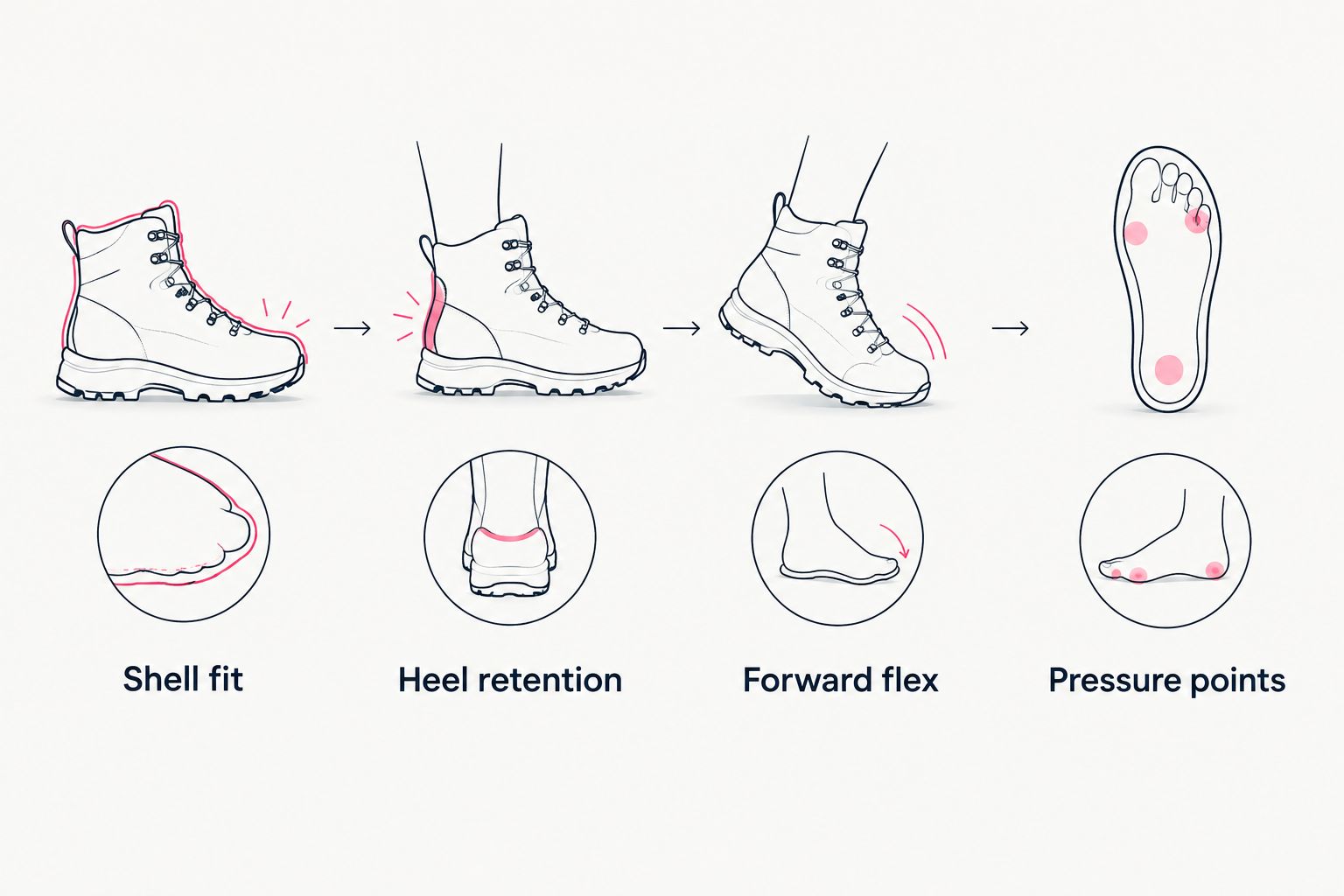
Repeat the checks on both feet. Differences between feet matter, and a fit that works on one side does not establish that the other side is correct.
The following cards identify the three fitting candidates discussed above. Use the product names to keep your comparison specific when you speak with the fitter.
Boots on this fitting shortlist


Separate boot problems from ski and binding problems
Better boots do not correct dull edges, damaged bases, or an unsuitable binding setup. If your skis skid unexpectedly or feel inconsistent, describe the snow conditions and the symptom before deciding the boot is responsible.
Skiboulder offers tuning as well as boot fitting. Discuss edge condition, base damage, and recent maintenance alongside fit complaints; do not request a particular edge angle simply because another skier uses it.
A boot change also requires a binding compatibility and adjustment assessment. Do not assume that a replacement boot works with the existing setup because it clicks into place. Sole type, boot sole length, and the binding’s requirements all matter.
Renting, leasing, or choosing retail boots
Daily rentals, seasonal leases, and retail boots serve different equipment needs. In 2026, choose the arrangement around how you use the equipment and how consistently it fits—not around an assumed progression from one arrangement to another.
| Equipment route | Best for | Advantage | Limitation |
|---|---|---|---|
| Daily rental | A specific ski outing | Equipment fitted for the outing | Fit and setup still require attention at pickup |
| Seasonal lease | Repeated use through a season | A season-based equipment arrangement | You must confirm inclusions and adjustment terms |
| Retail boots | A personal boot setup | Selection centered on your anatomy and skiing | Ownership does not eliminate fitting or maintenance needs |
Skiboulder offers rentals, seasonal ski leases, and retail equipment. Confirm which boots and services belong to the arrangement you are considering rather than assuming every package has identical inclusions.
If you already own boots, bring them before replacing them. A fitting assessment should establish whether the issue concerns shape, liner condition, closure tension, or a mismatch between support and movement.
How these boots were ranked
This 2026 ranking prioritizes stated intended use, then applies shell fit, retention, usable flex, and compatibility as selection requirements. It is a fitting shortlist, not an on-snow test score or a claim that one model fits more feet.
The all-mountain default comes first, the women’s all-mountain candidate second, and the freestyle candidate third. Any candidate that fails the fit checks drops out, regardless of rank.
Which ski boot should you choose?
Start with the Atomic Hawx Prime 120 S BOA GW if you are a strong all-mountain skier seeking substantial support. Choose the Atomic Hawx Prime 105 S BOA W GW as the women’s all-mountain fitting candidate, or the Dalbello iL MORO 90 3DWRAP when freestyle is your priority.
For an undecided skier, the next move is a fitting—not a blind selection from the table. At Skiboulder, explain your terrain, current equipment, and most repeatable fit problem so the conversation starts with your skiing.
FAQ
What are the best ski boots for intermediate to advanced skiers?
The best ski boots match your foot shape, support requirements, and terrain. Atomic Hawx Prime 120 S BOA GW is the strong all-mountain candidate here, Atomic Hawx Prime 105 S BOA W GW is the women’s all-mountain candidate, and Dalbello iL MORO 90 3DWRAP is the freestyle candidate.
Is a 120-flex ski boot too stiff for an intermediate skier?
A 120-flex boot is too demanding if you cannot flex it while maintaining balance and heel contact. Ability labels alone do not determine the right flex, and flex numbers are not standardized across brands.
Is BOA better than buckles for ski boot fit?
BOA is a closure option, not a guarantee of better fit. Compare pressure distribution and heel retention in the actual boots rather than choosing the closure before the shell.
Should my toes touch the front of my ski boots?
Light toe contact while standing upright can be normal, but cramped or curled toes are not the goal. Have a fitter assess shell length and how toe contact changes when you flex forward.
Can I use new ski boots with my existing bindings?
Only after compatibility and adjustment have been checked. A qualified technician must assess the actual boot sole and binding setup rather than relying on whether the boot clicks in.
Should I choose rental boots or personal ski boots?
Choose according to your equipment needs and the quality of fit you achieve. Rentals require careful fitting too, while personal boots still need assessment and maintenance.
One last thing
Do not erase your most useful fitting evidence by describing every problem as discomfort. Before your next visit, note whether the problem starts while standing, flexing, traversing, or turning, and identify the exact location. That description helps separate a foot-shape problem from a closure, movement, or equipment issue.
Related guides
NEED A TUNE OR A FRESH SETUP?
– BETTER SKIING

- Professional Wintersteiger base grinds
- Precision edge sharpening
- Phantom Glide treatments
- Full binding safety checks
BOOK YOUR TUNE

KEEP YOUR GEAR
MOUNTAIN-READY
Keep your gear running
smooth — bring it to the experts.
0 comments